Faceless Content Is Taking Over Social Media in 2026
On this page
- The Rise of Faceless Content Creators
- Why Creators Are Going Faceless
- Top Niches Dominating Faceless Content
- How Faceless Creators Actually Make Money
- How to Start as a Faceless Content Creator
- What This Trend Means for the Future of Content
- Frequently Asked Questions About Faceless Content
- Start Creating Faceless Content Today
Faceless content, where the creator never appears on camera, is now a mainstream format on YouTube, TikTok and Instagram. Channels like Kurzgesagt and Bright Side built audiences of tens of millions without an on-camera host, and AI tools such as EasyViral now write, voice, render and post faceless videos automatically, so anyone can start a channel without a camera.
This is not a passing fad. It is a structural shift in how content gets made, who makes it, and what audiences actually care about when they press play. Channels like Kurzgesagt (25 million+ subscribers with animated explainers), Bright Side (44 million subscribers), and Lofi Girl (15 million subscribers with a 24/7 lo-fi beats livestream) have proven that audiences connect with content, not faces.
The Rise of Faceless Content Creators
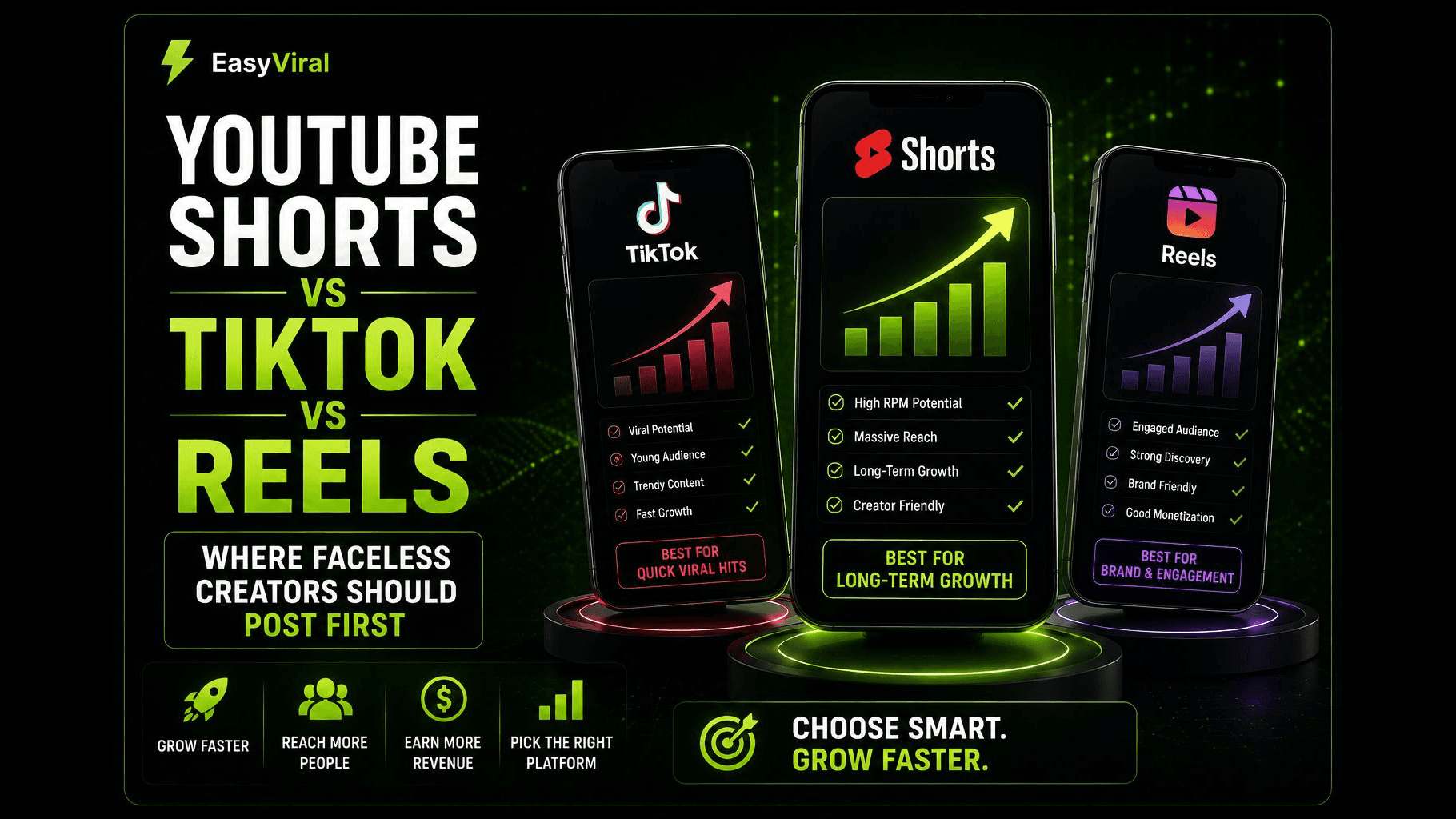
The growth is easy to see but hard to measure: no platform publishes how many channels are faceless, so be wary of precise shares you see quoted. What is measurable is the scale of short video itself: YouTube says Shorts now average 200 billion daily views.
On TikTok alone, faceless accounts in niches like finance tips, motivational content and satisfying videos are a familiar part of the For You feed, and on Instagram, psychology facts and life hack Reels follow the same formats.
The question most people ask is simple: why?
The answer is that audiences have evolved. The average social media user in 2026 scrolls through hundreds of pieces of content per day. They are not forming parasocial relationships with every creator they watch. They are consuming information, entertainment, and inspiration at speed. What matters is the quality of the hook, the clarity of the value, and the production quality of the delivery. Whether a human face is attached to it has become largely irrelevant for most content categories.
Platform documentation points the same way. YouTube says its recommendations are driven by what viewers choose to watch, how much of it they watch, and feedback such as likes, shares and surveys; a face on screen is not one of the signals it lists. The content either holds attention or it does not.
Why Creators Are Going Faceless
The surge in anonymous content creation is not driven by a single motivation. It is the convergence of several powerful forces that all point in the same direction.
Privacy and Personal Boundaries
The glamour of internet fame has worn thin. A generation of creators who watched early YouTubers deal with burnout, stalking, harassment, and the total erosion of personal privacy has drawn a clear conclusion: you can build a profitable media business without sacrificing your anonymity.
For many creators, especially those with day jobs, families, or simply a preference for keeping their personal and professional lives separate, going faceless is not a compromise. It is liberation. You can build a channel that generates significant revenue while still walking through a grocery store without being recognized. Camera anxiety alone filters out countless talented people who have valuable knowledge to share. The faceless format removes that barrier entirely.
Lower Production Barrier
Traditional face to camera content demands a surprising amount of infrastructure. You need good lighting, a presentable background, a quality camera, and the confidence to perform on screen. You need to manage your appearance and on camera energy across multiple takes. The production overhead is real, and it adds hours to every single video.
Faceless content strips all of that away. The production requirements shift entirely to scripting, visual sourcing, voiceover, and editing, skills that can be learned, systematized, and increasingly automated. The visual formats available are diverse: stock footage montages, AI generated imagery, screen recordings, whiteboard animations, motion graphics, data visualizations, or even simple slideshow formats. Each niche tends to gravitate toward the visual style that best serves its audience.
The efficiency gains are real: one script can be turned into several short videos without booking a single filming session.
Scalability
This is the factor that separates hobbyists from media entrepreneurs. When your content does not depend on your face, your voice (especially with AI voice options now available), or your physical presence, you can scale in ways that traditional creators simply cannot.
Some faceless creators run several channels at once, each targeting a different niche. The economics are straightforward: each channel is a standalone asset that generates its own revenue stream, and none of them require you to be on camera for eight hours a day.
This model has produced a new class of creator who thinks more like a media company executive than a solo influencer. They focus on systems, delegation, and content velocity rather than personal brand.
How AI Tools Accelerated Faceless Content Creation
Perhaps the most significant accelerant has been the rapid maturation of AI tools purpose built for video creation. Three years ago, producing a polished faceless video required hiring scriptwriters, voiceover artists, video editors, and music licensors. The cost per video made it impractical for anyone without significant upfront capital.
Today, a single creator armed with the right AI tools can produce content that is virtually indistinguishable from what a small production team would have delivered in 2023. Scripts, voiceovers, visual assembly, captioning, and music selection can all be handled through AI powered workflows, often in minutes rather than days.
This democratization has opened the door to creators in every country, every income bracket, and every skill level. The barrier to entry has never been lower.
Top Niches Dominating Faceless Content
Not all niches are equally suited to the faceless format. The ones that have thrived share common characteristics: they are information dense, visually flexible, and lend themselves to serialized content that keeps audiences coming back.
Finance and Investing
This was one of the earliest niches to go faceless at scale, and it remains one of the most profitable. Channels covering stock market analysis, cryptocurrency trends, personal budgeting, and passive income strategies have found that audiences respond to clear data visualization and authoritative narration far more than they respond to a talking head. Finance ad rates rank among the highest on YouTube, because advertisers pay more to reach viewers making money decisions.
True Crime and Scary Stories
The true crime explosion of the early 2020s found a natural home in the faceless format. These channels combine archival footage, atmospheric visuals, and compelling narration to tell stories that keep viewers watching for long stretches. The format translates exceptionally well to YouTube Shorts and TikTok as well, where condensed case summaries regularly go viral.
Psychology and Self Improvement
Content covering psychological concepts, cognitive biases, productivity frameworks, and personal development has become a powerhouse niche for faceless creators. The educational nature of the content pairs perfectly with clean visual presentations, and the audience tends to be highly engaged and loyal. These channels also tend to perform well across multiple platforms simultaneously.
AI and Technology News
There is a fitting irony in the fact that some of the most successful channels covering artificial intelligence are themselves produced almost entirely by AI tools. Tech news and explainer content moves fast, and faceless channels can publish multiple videos per week covering the latest developments without the bottleneck of scheduling on camera time.
Cooking and Life Hacks
Overhead cooking shots and step by step life hack demonstrations have been faceless content staples for years, but the category has matured significantly. Top channels in this space now produce cinematic quality content with professional narration and have built audiences in the tens of millions.
How Faceless Creators Actually Make Money
The monetization landscape for faceless content is robust and diversifying. Understanding the revenue mechanics is essential for anyone considering this path.
Ad Revenue and Monetization Thresholds
YouTube remains the primary ad revenue engine for faceless creators. The platform’s Partner Program requires 1,000 subscribers plus 4,000 qualified watch hours in 12 months or 10 million qualified Shorts views in 90 days. From February 1, 2027, new applicants need 8,000 hours or 20 million Shorts views (what changes in 2027). Earnings after that vary widely by niche, audience country and format.
TikTok’s Creator Rewards Program, which pays only for original videos at least one minute long, and Instagram’s bonuses, which are limited-time and invitation-only, provide additional revenue for creators who qualify. The strategy most successful creators follow is to use TikTok and Reels as audience acquisition channels that funnel viewers to their monetized YouTube presence.
Affiliate Marketing
Faceless content is exceptionally well suited to affiliate marketing because the content itself is often structured around recommendations, reviews, and tutorials. Finance channels promote brokerage accounts and financial tools. Tech channels promote software and gadgets. Self-improvement channels promote books and courses.
The key advantage is that faceless content feels less like a personal endorsement and more like an objective recommendation, which can suit recommendation-led content. Audiences perceive the content as information first rather than influence driven.
Selling Digital Products
Creators who build authority in their niches increasingly monetize through digital products: online courses, templates, ebooks, and membership communities. A faceless finance channel might sell a budgeting spreadsheet pack. A productivity channel might sell a Notion template library. Digital products have high margins because each extra sale costs almost nothing to deliver, and the faceless format creates no barrier to selling them.
For some channels, product revenue ends up larger than ad revenue.
How to Start as a Faceless Content Creator
If you are reading this and considering launching your own faceless content operation, you have two primary paths forward.
The Manual Approach
The traditional method involves assembling a workflow from disparate tools. You write scripts (or hire a writer), source stock footage from platforms like Pexels or Storyblocks, record or commission voiceover, edit everything together in Premiere Pro or DaVinci Resolve, add captions manually, and source royalty-free music. This approach gives you maximum creative control but demands significant time investment per video, typically 4-8 hours for a polished piece, and a learning curve across multiple software platforms.
The AI-Automated Approach
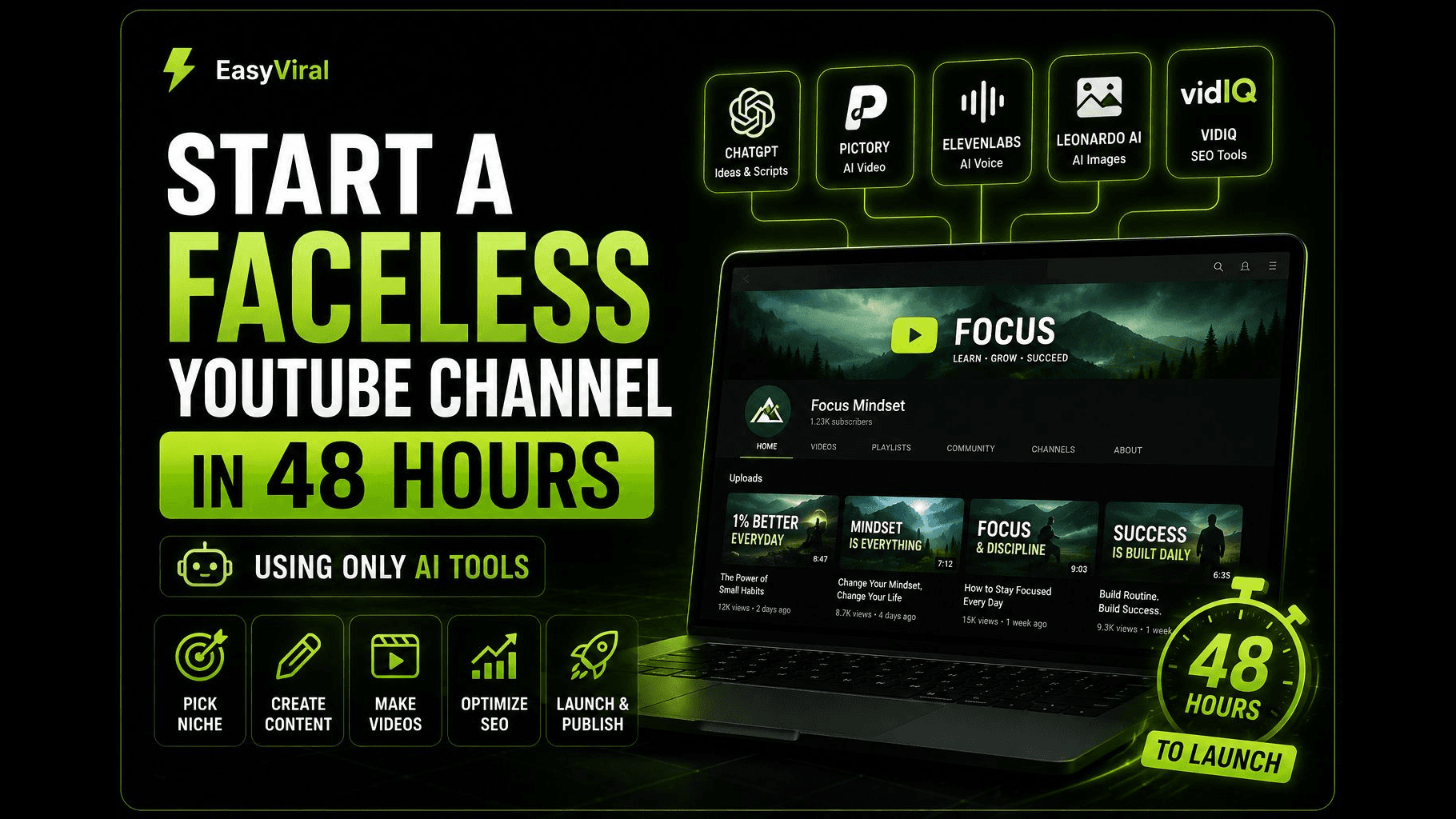
The alternative is to use a platform designed specifically for faceless video production. Tools like EasyViral.ai have compressed the entire production pipeline into a single workflow: AI generated scripts, AI generated scenes, AI voiceover (12 English voices and 9 to 14 in each of its 11 languages, plus voice cloning), captions, background music, and series that generate and post videos on a schedule. Pricing starts at $9 per month, which puts it within reach of virtually anyone.
The AI approach is particularly compelling for creators who want to test multiple niches quickly or who plan to operate several channels simultaneously. What used to require a team now requires a laptop and an idea.
Whichever path you choose, the operational fundamentals remain the same: pick a niche with proven demand, commit to a consistent publishing schedule, optimize your titles and thumbnails for click through rate, and let the algorithm do its work.
What This Trend Means for the Future of Content
The rise of the faceless content creator is not just a trend story. It is a signal about where digital media is heading.
First, it signals the continued unbundling of "creator" from "personality." The creator economy’s first wave was built on personal brands. The second wave is being built on content brands, where the value lives in the channel’s identity, its niche authority, and its content library rather than in any individual person. This makes creator businesses more transferable, more scalable, and more resilient.
Second, it signals that AI is not replacing creators but rather redefining what it means to be one. The most successful faceless creators in 2026 are not technical experts or AI engineers. They are people with sharp editorial instincts who understand what their audience wants to watch, learn, or feel. AI handles the production. Humans handle the strategy.
Third, it signals that the barriers to media entrepreneurship are collapsing in real time. Five years ago, launching a content business required either significant capital or significant on camera talent. Today, it requires neither. A person with domain expertise in any subject, access to AI production tools, and the discipline to publish consistently can build a media asset that generates meaningful revenue.
The implications extend beyond individual creators. Brands are adopting faceless content strategies for their social media presences. Educators are using the format to reach students without the overhead of traditional video production. Small businesses are building niche authority channels as content marketing engines.
We are still in the early stages of this transformation. The tools are getting better, the audiences are getting larger, and the monetization options are getting more diverse. For anyone who has thought about building a presence on social media but has been held back by the prospect of putting their face on camera, the message from 2026 is clear: you do not have to.
Frequently Asked Questions About Faceless Content
What is a faceless content creator?
A faceless content creator produces videos, reels, or shorts without ever appearing on camera. Instead of a talking head, these creators use stock footage, AI generated visuals, screen recordings, animations, or motion graphics combined with voiceover narration. The creator’s identity stays private while the channel builds an audience and generates revenue.
Is faceless content allowed on YouTube and TikTok?
Yes. YouTube, TikTok and Instagram all allow faceless content, and none of them requires a face for monetization. The same rules apply to everyone: YouTube’s Partner Program excludes mass-produced or repetitive videos under its inauthentic content policy, TikTok’s Creator Rewards Program (which replaced the Creativity Program) pays only for original videos at least one minute long, and Instagram’s bonuses are limited-time and invitation-only.
How much do faceless content creators earn?
Earnings vary widely by niche and audience size. No platform publishes earnings by niche, and income depends on views, audience country, niche and how many revenue streams you run. On YouTube, creators keep 55% of net ad revenue on their long-form videos and 45% of their Shorts Creator Pool allocation.
What are the best niches for faceless content in 2026?
The highest performing faceless content niches in 2026 are personal finance and investing, technology and AI news, true crime and scary stories, psychology and self improvement, and cooking or life hack channels. The best niche for you balances high advertiser demand with your ability to produce content consistently.
Do I need editing skills to create faceless videos?
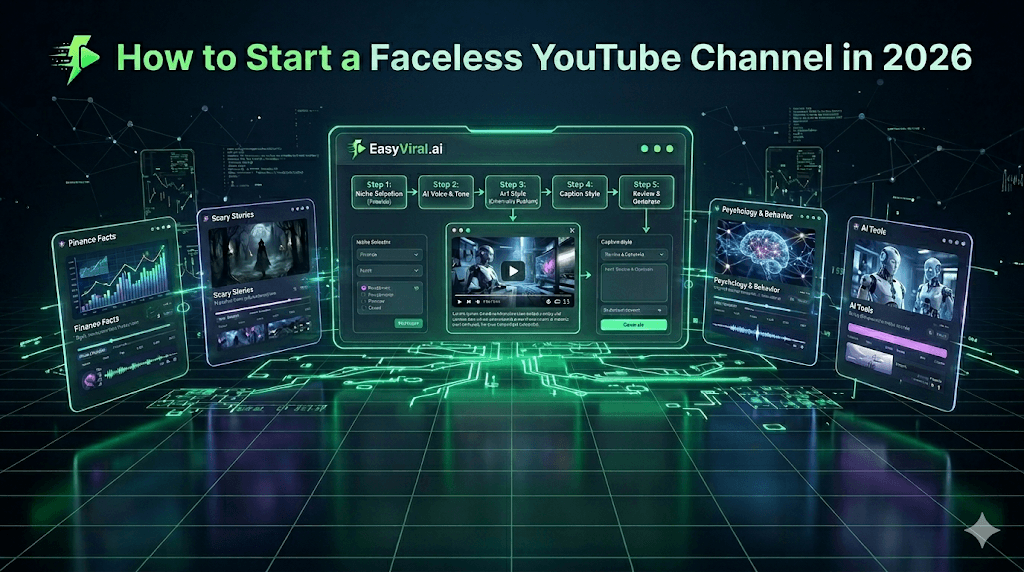
No. AI video platforms like EasyViral handle the entire production process, scripting, AI-generated scenes, voiceover, captions and music, without requiring any editing skills. You fill in a short wizard and EasyViral produces the video for you. For creators who prefer manual control, free tools like DaVinci Resolve and CapCut work well but require a learning curve and 2-4 hours per video.
How do I start a faceless content channel?
Pick a niche with proven demand, set up accounts on YouTube, TikTok, and Instagram, and commit to posting at least one video per day. Use an AI faceless video tool or build a manual workflow with free editing software and stock footage. Focus on volume and consistency in the first 90 days, then optimize based on your analytics. Monetization timelines vary widely, and YouTube’s Partner Program needs 4,000 qualified watch hours or 10 million qualified Shorts views on top of 1,000 subscribers.
Start Creating Faceless Content Today
The barrier between having an idea and publishing a faceless video has never been lower. EasyViral turns the entire production process into a 5-step wizard: pick your niche from 38 options or your own, choose a voice (12 in English, 9 to 14 in each of its 11 languages, or your own clone), an art style and captions, and schedule. Series automation generates and posts each video to TikTok, Instagram or YouTube on the dates you pick, without touching an editor.
Plans start at $9/month. Whether you are testing a single niche or running multiple channels, EasyViral handles the production so you can focus on strategy and growth.