Faceless Finance Channels: The Highest-RPM Niche Breakdown for 2026
On this page
Finance is the highest-paying niche in faceless YouTube. That's not really a debate anymore. While motivation channels earn $3-5 per 1,000 views and Reddit story channels scrape by at $2-5, finance creators are pulling $12-45 RPM depending on the sub-niche.
But "finance" is a broad category. A credit card review channel and a crypto prediction channel are both "finance," yet one earns 5x more per view than the other. The sub-niche you pick within finance determines your revenue ceiling, your competition level, and your monetization options beyond ads.
This post breaks down every major finance sub-niche with real RPM data, shows you what's saturated versus what's still wide open, and covers how faceless finance creators are building income streams that go far beyond AdSense.
RPM by finance sub-niche: the full breakdown
Not all finance content pays the same. The RPM gap between the highest and lowest-paying sub-niches is massive, and it comes down to one thing: how much advertisers are willing to pay to reach your audience.
The top tier: $25-$45 RPM
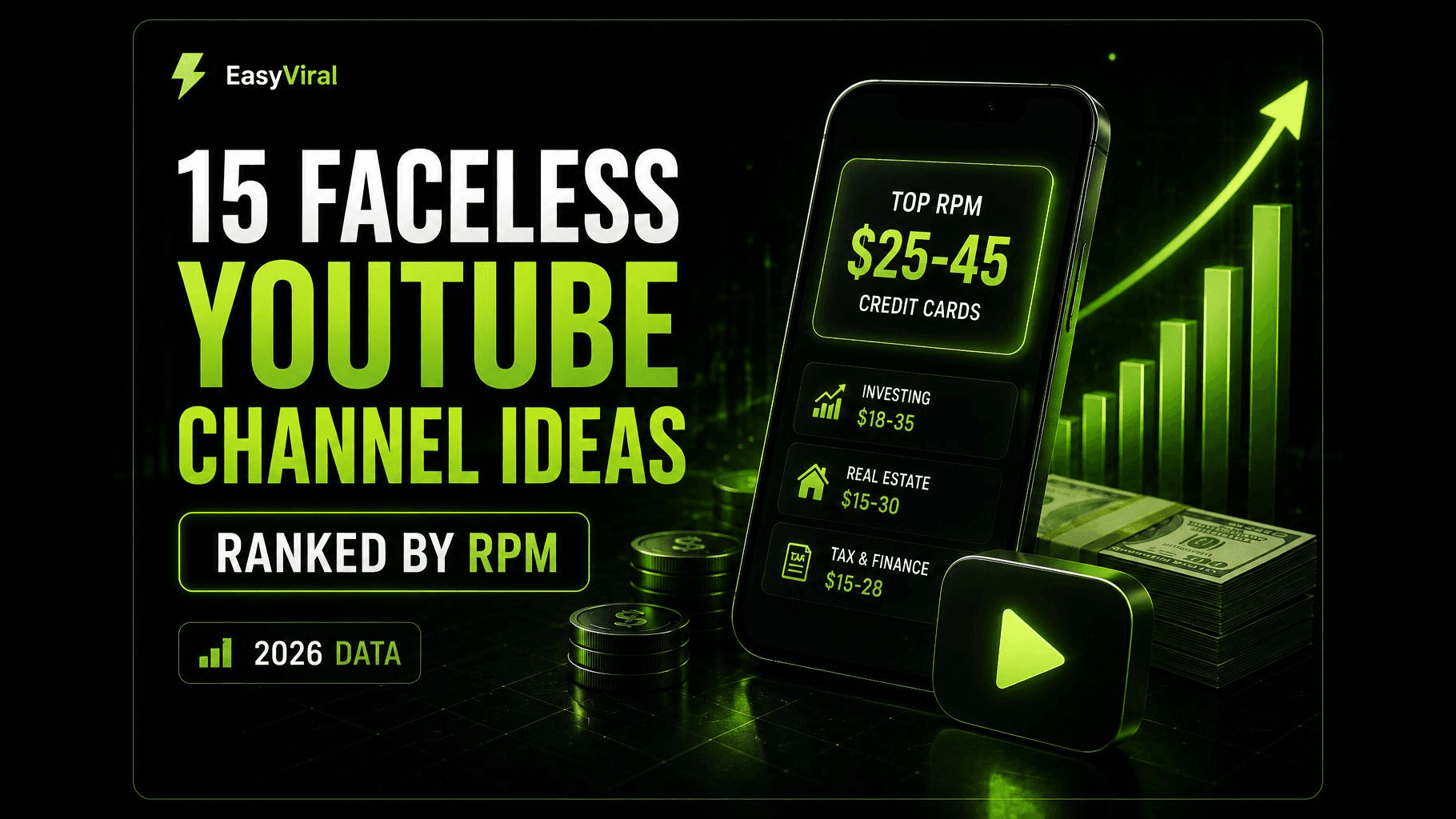
Credit cards and credit score content sits at the absolute top with RPMs between $25 and $45. This is the highest-paying sub-niche on all of YouTube, not just within finance. The reason is simple: credit card companies spend aggressively on customer acquisition. A single approved credit card application is worth $50-$200 to the issuer, so they'll pay premium ad rates to reach people actively watching credit score content.
The content works well for faceless channels. Comparison videos ("best cash back cards in 2026"), credit score improvement guides, and reward point strategy breakdowns. Screen recordings of card comparison tools with a voiceover explaining the details. No face needed.
The high tier: $15-$35 RPM
Investing and stock market content earns $18-$35 RPM. Brokerage platforms, financial advisors, and fintech apps are the primary advertisers. Videos covering index fund strategies, portfolio breakdowns, and market analysis attract viewers with disposable income, which is exactly the audience these advertisers want.
Real estate investing pulls $15-$30 RPM. Mortgage companies, real estate platforms, and investment software drive these rates. Content covering rental property analysis, REIT breakdowns, and housing market data performs well in faceless formats because the visuals are naturally data-heavy (charts, property listings, financial models).
Tax tips and accounting earns $15-$28 RPM. This sub-niche spikes heavily in Q1 (tax season) but maintains solid rates year-round for content about deductions, business structure, and tax optimization. Accounting software companies and financial planning firms are consistent advertisers.
The mid tier: $8-$22 RPM
Personal finance and budgeting earns $12-$22 RPM. This is the broadest finance sub-niche and the most accessible entry point. Budget breakdowns, savings strategies, and "how I saved $X in Y months" content resonates with a wide audience. The RPM is lower than credit cards or investing because the viewer's purchasing intent is less immediate, but the audience size is much larger.
"Make money online" and side hustle content pulls $10-$20 RPM. This category has high search volume and attracts SaaS, course, and tool advertisers. The challenge is that it’s also one of the most saturated sub-niches in all of YouTube. Standing out requires specific, actionable content rather than generic "5 ways to make money" lists that have been done thousands of times.
Cryptocurrency earns $8-$20 RPM with significant volatility. Crypto RPMs crashed in 2022-2023 but have rebounded in 2026 thanks to ETF-related advertising spend. The RPM swings with market sentiment. During bull runs, crypto ad rates spike. During downturns, advertisers pull back and your RPM can drop 50% in a month.
The lower tier: $8-$15 RPM
Debt payoff and frugality content earns $8-$15 RPM. This is the lowest-paying finance sub-niche because the audience is actively trying to spend less money. Advertisers know these viewers aren't about to sign up for a premium credit card or open a brokerage account. The content can still be profitable at scale, but the per-view revenue is roughly half of what credit card content earns.
The Q4 factor
All finance sub-niches get a seasonal boost in Q4 (October through December). Advertisers increase their budgets for year-end spending, and finance RPMs typically jump 30-50% above their annual average. A credit card channel earning $30 RPM in June might hit $45+ RPM in November. Plan your best content for Q4 if you want to maximize ad revenue.
What faceless finance content actually looks like
If you've never watched a successful faceless finance channel, you might assume the format is just stock footage with a voiceover. Some channels do that. The best ones don't.
Here are the visual formats that work in finance:
Custom animations and motion graphics. Channels like Economics Explained (roughly 3 million subscribers, estimated $30,000-$55,000/month from ads) use clean animated explainers to break down complex financial concepts. The animations aren't elaborate. Simple shapes, charts, and icons that move in sync with the narration. What makes them work is clarity, not production value.
Whiteboard-style explainers. The Swedish Investor (roughly 1 million subscribers) uses a hand-drawn whiteboard format to summarize financial books and investment concepts. The style feels personal without showing a face. It's also relatively cheap to produce.
Screen recordings with callouts. Credit card and investing channels often use screen recordings of financial tools, comparison websites, or brokerage platforms, with arrows, highlights, and text callouts explaining what the viewer is seeing. This format works because it shows real tools the viewer can use themselves.
Data visualization. Charts, graphs, and financial models animated to move as the narrator explains them. This is particularly effective for real estate analysis, stock comparisons, and market trend content. The data itself is the visual.
Stock footage composites. The most common but least differentiated approach. B-roll of city skylines, office buildings, and people working at computers, layered with text overlays and voiceover. It works, but it's what every other faceless finance channel does too. If you go this route, the script and voiceover quality need to be significantly above average to compensate for the generic visuals.
Monetization beyond ads: where finance channels really make money
Ad revenue is substantial in finance, but for channels past the 50,000-subscriber mark, it's often not the largest income stream. Here's where the rest comes from.
Affiliate marketing: the biggest earner
Finance affiliate programs pay some of the highest commissions on the internet. Credit card referrals typically pay $50-$150+ per approved application through affiliate networks. Programs from issuers like American Express, Chase, Capital One, and Discover are widely available through major networks. A single credit card review video that ranks well can generate $500-$2,000/month from affiliate links alone.
Investment platform referrals are similarly lucrative. Brokerages like Webull, M1 Finance, and Robinhood all run referral programs that pay anywhere from $5 to $100+ per qualified account, depending on the platform and deposit tier. The exact payouts change frequently, but the direction is clear: these platforms spend heavily on customer acquisition, and creators with consistent traffic benefit directly.
Finance creators running affiliate programs report averages in the range of $5,000-$10,000/month from affiliates, with commission rates typically running 20-40%. For channels in the credit card and investing sub-niches, affiliate income frequently exceeds ad revenue.
The key for faceless channels is integration. The affiliate recommendation needs to feel like part of the content, not a tacked-on pitch. A video comparing the best index fund brokerages that naturally links to those brokerages in the description performs far better than a generic "link in bio" approach.
Sponsorships: premium rates
Finance channels command the highest sponsorship rates on YouTube. The benchmark is $50-$200 CPM (cost per thousand views) for sponsored integrations, which puts finance at the top of all verticals.
In practical terms: a finance channel averaging 80,000 views per video should charge $6,000-$12,000 per sponsored integration in 2026. Smaller channels with 30,000 median views and a Tier 1 audience (US/UK/AU) can charge around $1,200 for a 60-second mid-roll placement.
Faceless channels do face a slight disadvantage here. Brands sometimes prefer personality-driven creators because the personal endorsement feels stronger. But faceless finance channels with strong audience demographics (high-income, US-based viewers) still attract sponsors consistently. The audience data matters more than the face behind it.
One negotiation tip: brands in finance typically open 30-40% below their actual budget. The first offer is almost never the best offer.
Digital products: the highest-margin play
Budget templates, investment trackers, and financial planning spreadsheets sell well on platforms like Gumroad and Etsy. Courses covering specific financial strategies sell for $500-$5,000+. One-on-one coaching commands $200-$1,000+ per session.
The margins on digital products run 85-95%, which makes even modest sales volume highly profitable. A faceless finance channel with 100,000 subscribers that sells a $47 budgeting spreadsheet to just 1% of its audience generates $47,000 from a single product.
What a realistic income stack looks like
For a faceless finance channel at roughly 150,000 subscribers with consistent uploads:
Ad revenue: $2,500-$5,000/month. Sponsorships: $8,000-$15,000/month. Affiliate commissions: $3,000-$9,000/month. Digital products: $2,000-$8,000/month. Total range: $15,500-$37,000/month.
At this level, ad revenue accounts for maybe 15-20% of total income. The bulk comes from sponsorships and affiliates. This is why optimizing for RPM alone misses the bigger picture. The real value of finance content is the high-intent audience it attracts, and the multiple ways you can monetize that audience beyond ads.
What's saturated and what's still open
Not every finance sub-niche is worth entering in 2026. Some are so crowded that breaking through is nearly impossible without a massive budget or an angle nobody else has tried.
Oversaturated (proceed with caution)
Generic budgeting advice. "How to save money" and "5 budgeting tips" videos have been done to death. Unless you have a truly unique angle (country-specific advice, profession-specific strategies), this space is too crowded to rank in.
"Make money online" listicles. The competition here is extreme, and much of it is low-quality, which makes YouTube's algorithm more cautious about promoting new entrants.
Crypto price predictions. These spiked in 2021 and again in 2024, but the audience is fickle, the RPM swings wildly, and YouTube has cracked down on channels promoting specific trades or tokens.
Undersaturated (real opportunity)
Tax strategy content for specific demographics. Content targeting freelancers, expats, small business owners, or retirees with niche tax strategies is undersupplied relative to demand. The RPM is high ($15-$28) because accounting software and financial planning firms advertise aggressively in this space.
Financial data visualization and analysis. Channels that turn public financial data into visual stories (housing market trends by city, stock sector performance breakdowns, inflation impact calculators) are rare. The format is a natural fit for faceless production and the content ages well.
AI and fintech tool reviews. As new financial tools launch constantly, there's steady search demand for reviews and comparisons. This sits at the intersection of tech and finance, pulling premium ad rates from both categories.
Gen Z personal finance. Content specifically framed for younger audiences (first job money moves, student loan strategy, investing with small amounts) is growing fast as a search category but has relatively few dedicated faceless channels.
The YMYL factor: YouTube's extra scrutiny on finance
Finance falls under YouTube's YMYL (Your Money, Your Life) guidelines, which means your content faces additional scrutiny compared to entertainment or lifestyle channels.
In practical terms, this means a few things:
You need an on-screen disclaimer in the first 10 seconds of any video that discusses financial strategies, investments, or money management. Something like "This is for educational purposes only and is not financial advice." Missing this disclaimer can tank your RPM to near-zero because advertisers avoid content flagged as unqualified financial advice.
YouTube will evaluate your channel's perceived expertise over time. Channels that cite sources, reference real data, and demonstrate financial literacy get better distribution than channels that make unsubstantiated claims. This actually benefits faceless creators who focus on research-heavy, data-driven content.
The YMYL guidelines also mean that pump-and-dump schemes, coordinated trading promotion, and misleading income claims will get your channel terminated. YouTube is stricter about this in finance than in almost any other category. Keep the content educational and data-backed, and you'll stay well within the guidelines.
Getting started: the practical path
If you're building a faceless finance channel from scratch, here's the approach that the data supports:
Pick a specific sub-niche rather than covering "finance" broadly. Credit card content has the highest RPM, but tax strategy and financial data visualization have less competition. Choose based on what you can produce consistently and what aligns with the affiliate programs you want to promote.
Build your affiliate strategy from day one, not after you hit 100,000 subscribers. Every video should have a relevant affiliate link in the description, even while your view counts are small. The conversion rates on finance content are high because viewers watching a credit card comparison video are already in a buying mindset.
Include disclaimers in every video. Not just for compliance, but because it signals to YouTube's systems that you're a responsible finance creator, which helps with ad placement quality and RPM.
Vary your visual format. If every video uses the same stock footage template, you'll trigger YouTube's repetitive content filter. Mix animations, screen recordings, data visualizations, and stock footage to keep each video feeling distinct even within the same sub-niche.
Target Q4 with your best content. The RPM premium in October through December is real and significant. Plan your highest-effort videos for that window.
Finance isn't the easiest faceless niche to start with. The content requires more research than motivation clips or Reddit story compilations. But the revenue ceiling is in a different league. A well-executed faceless finance channel with diversified monetization can realistically cross $15,000-$30,000/month within 18-24 months. No other faceless niche comes close to that consistently.