How Much Do Faceless YouTube Channels Actually Make in 2026? (Real Numbers)
On this page
- How YouTube actually pays faceless creators
- RPM by niche: where the real money is
- Income tiers: what channels actually earn at each stage
- Revenue beyond AdSense: where the smart money is
- The realistic timeline from zero to paid
- The geography factor most people ignore
- A warning about 2026 specifically
- The bottom line
Faceless YouTube channels are everywhere in 2026. Reddit stories, AI-animated explainers, horror compilations, finance breakdowns. They're pulling millions of views without a single person ever appearing on camera.
But here's the question nobody answers with actual numbers: how much money are these channels making?
Not "you can earn a lot!" fluff. Not "results may vary" disclaimers. Real RPM data, real income tiers, and a realistic timeline from zero to your first $1,000 month.
We pulled numbers from creator income reports, YouTube analytics screenshots, and industry research to put together the most honest breakdown you'll find on this topic.
Let's get into it.
How YouTube actually pays faceless creators
Before we talk numbers, let's make sure we're on the same page about how the money works.
YouTube pays creators through the YouTube Partner Program (YPP). To qualify in 2026, you need one of two paths:
- Path 1 (long-form): 1,000 subscribers + 4,000 watch hours in the past 12 months.
- Path 2 (Shorts): 1,000 subscribers + 10 million Shorts views in the past 90 days.
Once you're in, revenue comes from ads placed on your content. The key metric is RPM (Revenue Per Mille), which is how much you earn per 1,000 views after YouTube takes its cut.
For long-form content, YouTube keeps 45% and you keep 55%. For Shorts, the split is worse. YouTube keeps 55%, you keep 45%. And if your Shorts use copyrighted music, a single track cuts your earnings by roughly 33%.
RPM by niche: where the real money is
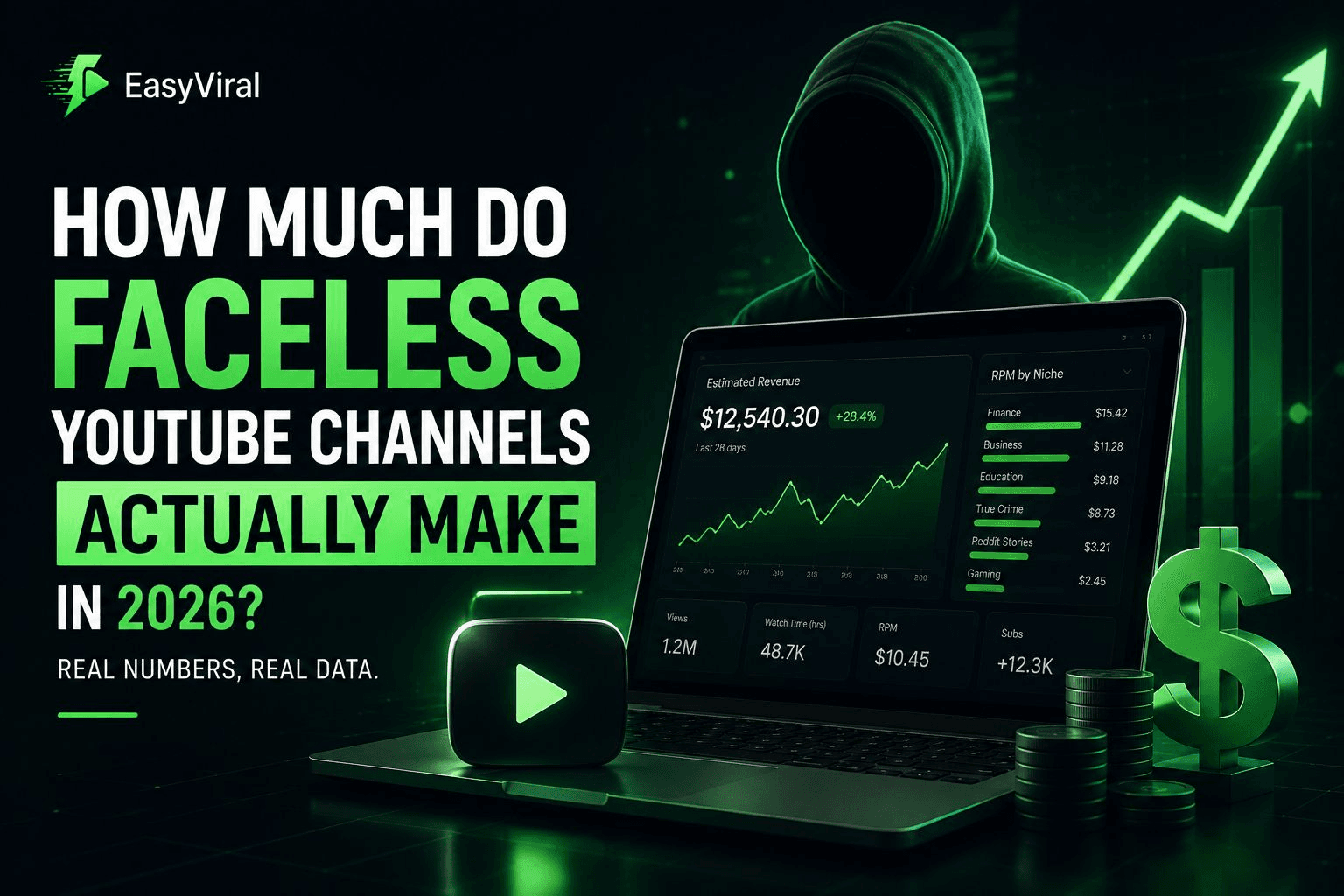
Not all faceless niches are created equal. The difference between a gaming compilation channel and a finance explainer channel can be 5 to 10x in revenue per view.
Here's what the data actually looks like in 2026:
High RPM niches ($8-$25 per 1,000 views)
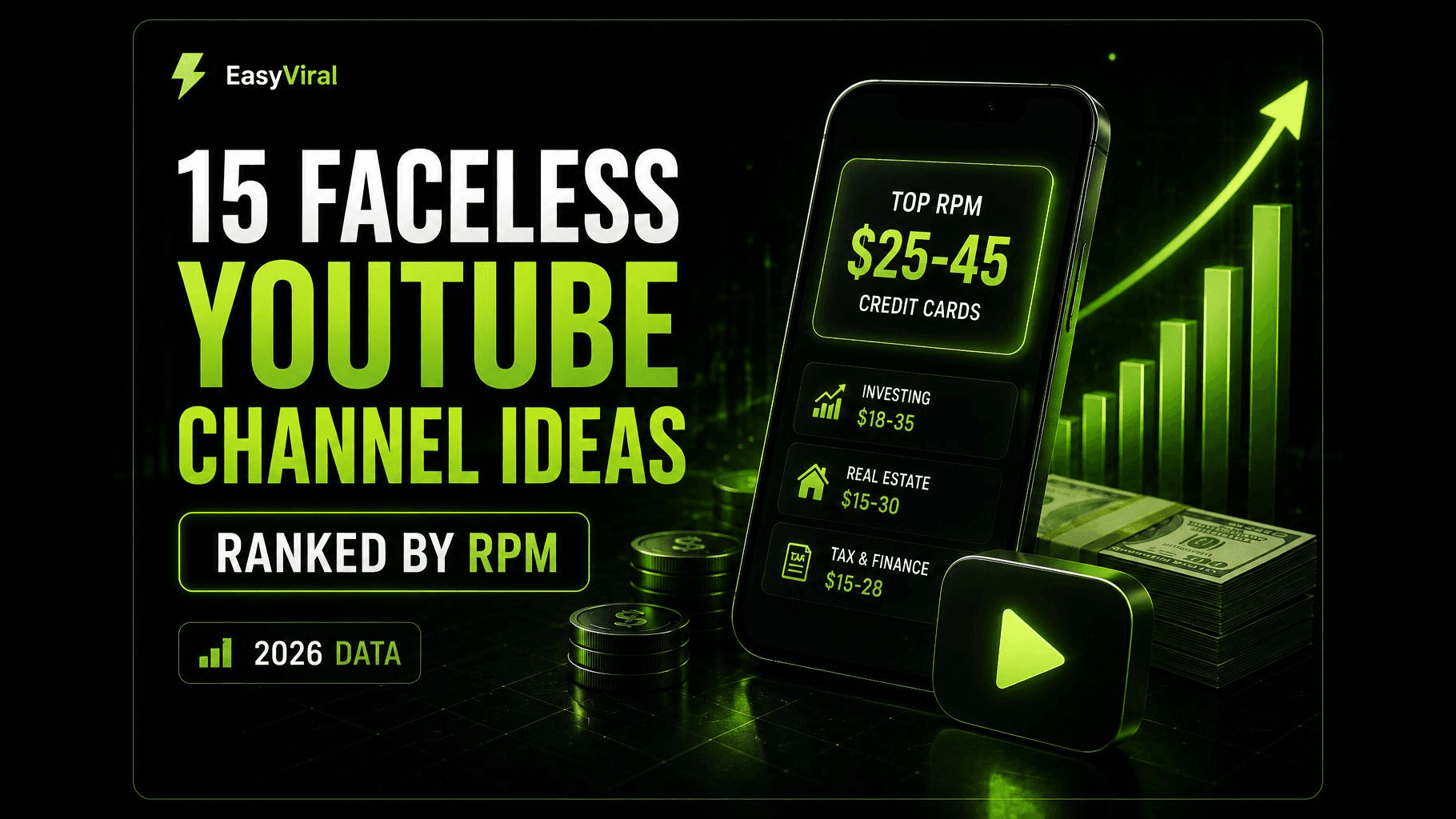
Finance and investing sits at the top with RPMs between $9 and $21. Advertisers in financial services (brokerages, credit cards, fintech apps) pay premium rates because the audience has high purchasing power. Sub-niches like "make money online" content can push even higher, reaching $10-$25 RPM.
Health and medical explainers pull $8-$18 RPM. Pharmaceutical and supplement advertisers drive these rates. Senior health and longevity content specifically averages around $6.17 RPM, which is still solid when paired with consistent upload volume.
True crime and mystery content earns $8-$13 RPM. High watch time (people binge these) combined with a broad audience keeps advertiser interest strong.
Education and animated storytelling land in the $9-$14 RPM range. Literary analysis channels average about $9.15 RPM, while general educational content stays competitive because of high audience retention.
Mid RPM niches ($5-$12 per 1,000 views)
Motivation and self-improvement channels earn $6-$12 RPM. The audience skews younger, which slightly reduces ad rates compared to finance, but the volume potential is enormous. Motivation clips perform exceptionally well as Shorts.
Tech and AI news earns $5-$12 RPM. B2B and SaaS advertisers target this audience, but the RPM range is wide because it depends heavily on whether your audience is US-based or global.
History and documentary-style content also falls in the $5-$12 RPM range. These channels benefit from long watch sessions but often attract a geographically diverse audience, which dilutes the average RPM.
Psychology and philosophy content (think Jungian analysis, stoic philosophy) averages around $7.13 RPM, a surprisingly stable niche with loyal viewership.
Low RPM niches ($2-$5 per 1,000 views)
Reddit stories and commentary channels typically earn in the $2-$5 RPM range based on creator reports. These are among the easiest faceless channels to start but also the most saturated. The RPM is low because advertisers know the audience is casually browsing, not actively shopping.
Gaming compilations sit at the bottom with $2-$4 RPM. The audience is young, ad-blockers are common, and the content is easily replaceable. Volume is the only path to meaningful revenue here.
| Tier | Niches | RPM Range |
|---|---|---|
| High | Finance, Health, True Crime, Education | $8-$25 |
| Mid | Motivation, Tech/AI, History, Psychology | $5-$12 |
| Low | Reddit Stories, Gaming Compilations | $2-$5 |
Shorts RPM: a different game entirely
YouTube Shorts RPM is $0.01-$0.07 per 1,000 views. That's not a typo. Even with 10 million monthly views on Shorts, you're looking at roughly $500/month from ads alone.
Shorts aren't a revenue engine. They're a subscriber growth engine. Channels that use Shorts grow 41% faster on average. The smart play is using Shorts to build your audience, then converting those subscribers into long-form viewers where the real RPM lives.
Income tiers: what channels actually earn at each stage
Here's what faceless channel earnings look like at different subscriber counts, based on aggregated creator data:
1K-10K subscribers: $50-$500/month
This is the grind phase. Your videos are getting some traction, the algorithm is starting to understand your content, but views are inconsistent. At this stage, most of your earnings come from AdSense alone.
A finance channel at 8K subscribers pulling 100K monthly views at $12 RPM earns roughly $1,200/month. A Reddit stories channel at 8K subscribers with the same view count at $3 RPM earns $300/month.
Niche selection is the biggest lever at this stage.
10K-100K subscribers: $500-$10,000/month
This is where faceless channels get interesting. The algorithm consistently recommends your content, upload frequency compounds, and non-ad revenue starts kicking in.
A true crime channel at 50K subscribers with 500K monthly views at $10 RPM earns around $5,000/month from ads. Add affiliate links in descriptions and the occasional sponsorship, and you're looking at $7,000-$8,000/month total.
Channels that diversify beyond ads at this stage consistently out-earn those that don't.
100K-1M subscribers: $1,000-$50,000+/month
The range is wide here because it depends entirely on niche, content format, and revenue diversification. A gaming compilation channel at 500K subscribers might earn $3,000/month. A finance channel at the same subscriber count might earn $30,000/month.
At this level, brand deals and affiliates often exceed ad revenue. 76% of top Shorts creators earn more from brand deals than from ads, and only 8% rely on ad revenue as their primary income source.
The outliers: $100K+/month
Channels like Daily Dose of Internet (20M subscribers) earn an estimated $70K-$400K/month depending on the source and season. DaFuq Boom pulls $500K-$1.3M/month. Noah Morris runs approximately 20 faceless channels with over 2.5 million combined subscribers, generating substantial six-figure annual revenue.
These are outliers. But they prove the ceiling for faceless content is much higher than most people expect.
Revenue beyond AdSense: where the smart money is
If you're only counting ad revenue, you're looking at maybe 40 to 60% of what a well-run faceless channel actually earns. Here's where the rest comes from:
Affiliate marketing: $2,000-$20,000/month
A single well-placed affiliate link on a channel with 100K+ monthly views can generate $500-$2,000/month. Educational and finance channels average $15,551/month from affiliates alone, sometimes exceeding their ad revenue.
The key is relevance. A finance channel linking to trading platforms or budgeting apps converts far better than random product links.
Sponsorships: $200-$10,000 per video
Short-form sponsorships pay $200-$2,000 per video. Long-form integrations in targeted niches range from $500-$10,000. Faceless channels have a harder time landing sponsors than personality-driven channels, but it's far from impossible. Your audience demographics matter more than your face.
Digital products: $1,000-$50,000/month
This is the biggest unlock most faceless creators ignore. Educational content channels that sell courses, templates, or tools through their funnel can earn $1,000-$50,000/month from digital products alone.
The Q4 multiplier
Don't forget seasonality. October through December earnings spike 70-100% higher than January. Advertisers spend aggressively during the holiday season, and your RPM across every niche benefits. A channel earning $3,000/month in March might pull $5,000-$6,000 in November with the same view count.
The realistic timeline from zero to paid
Let's kill the "I went from zero to $10K/month in 30 days" fantasy. Here's what a realistic timeline looks like for a faceless channel uploading 3-5 times per week in a mid-to-high RPM niche:
Months 1-3: The silent period. Most videos get under 100 views. You're building a library that the algorithm hasn't started recommending yet. Building a library of consistent uploads is key. Most creators report traction kicking in after their first 30-50 videos, though YouTube evaluates each video individually on engagement metrics. Subscriber count: 0-500. Revenue: $0.
Months 3-6: First signs of traction. Some videos start getting picked up by browse and suggested. If you're in a high-retention niche (true crime, finance, education) and uploading consistently, you can hit 1,000 subscribers and qualify for YPP. Revenue: $0-$200/month.
Months 6-12: Building momentum. Your content library is deep enough that the algorithm consistently recommends you. First real AdSense payments arrive. This is where most creators either quit or commit. Revenue: $200-$2,000/month depending on niche.
Months 12-18: Scaling. Channels that found their format and maintained consistency start hitting $2,000-$5,000/month. Affiliate and sponsorship income begins supplementing ads.
Months 18-24: Compounding. With 100+ videos live, multiple traffic sources feeding into your channel, and diversified revenue, well-run channels reach $5,000-$10,000+/month.
The trade-off with faceless content is that it often requires a larger library of uploads to build algorithmic trust compared to personality-driven channels. But faceless content is infinitely more scalable. You can run multiple channels simultaneously, which is nearly impossible when you're the on-camera talent.
The geography factor most people ignore
Your RPM doesn't just depend on your niche. It also depends on where your audience lives.
US-based viewers generate the highest ad rates. A finance channel with a primarily American audience earns $7.46-$30 RPM. The same content watched primarily by viewers in India drops to $0.80-$3 RPM. That's a potential 10x difference from the exact same video.
UK viewers pay around $6.35-$25 RPM. Australia and Canada fall in the $7-$25 RPM range. The global median is just $1.38 RPM.
This is why language and targeting matter. English-language content aimed at North American and European audiences is far more valuable per view than content with a global audience. EasyViral's one-click translation feature is actually strategic here. You can create a primary English channel for high-RPM markets and translated versions for volume in other regions.
A warning about 2026 specifically
Earlier this year, YouTube suspended monetization on thousands of AI-generated faceless channels under its "inauthentic content" policy. The platform later clarified that faceless channels are allowed. They're only targeting low-effort, mass-produced content that adds no real value.
What this means for you: quality matters more than ever. Channels that pump out generic AI-narrated slideshows are getting flagged. Channels that use AI tools to create engaging, well-produced content are thriving.
The creators making real money in 2026 aren't the ones cutting corners. They're the ones using AI to work smarter (better scripts, better visuals, faster production) while maintaining a quality bar that YouTube's algorithm rewards.
The bottom line
Faceless YouTube channels are a legitimate business model in 2026. The data is clear on that.
But the range of outcomes is enormous. A gaming compilation channel might struggle to hit $500/month. A well-executed finance channel with diversified revenue can cross $10,000/month within 18 months.
The variables that matter most are niche selection (which determines your RPM ceiling), upload consistency (which determines how fast the algorithm picks you up), and revenue diversification (which determines your actual take-home).
If you're starting a faceless channel today, pick a high-RPM niche, commit to 3-5 uploads per week, and think about affiliate and digital product revenue from day one. Not as an afterthought once you've "made it."
The channels making real money in 2026 aren't waiting to figure out monetization. They're building it into their strategy from the first upload.