How to Make AI Videos That Don't Feel Like AI Slop (And Why It Matters in 2026)
On this page
To make AI videos that don't feel like slop, keep the human decisions and let AI do the labor: rewrite every AI script with a real point of view, use a voice that fits your channel, pick visuals that match each line, pace the edit on purpose, and vary formats between uploads. YouTube's monetization rules target mass-produced, template-made AI content, not the use of AI tools.
You know the type: a robotic voice reads facts scraped from Wikipedia over stock footage that has nothing to do with the words. People call it "AI slop," and YouTube says it is actively working to reduce it.
In January 2026, Tubefilter reported that at least 18 channels from Kapwing's list of top AI slop channels had been deleted or had their videos hidden. The same month, YouTube CEO Neal Mohan listed "Managing AI slop" among his priorities in his 2026 letter, while comparing AI to earlier creative tools like the synthesizer, Photoshop and CGI. His position: AI tools are welcome on the platform. Low-effort AI content is not.
But here's the thing most people get wrong about this conversation. AI tools are not the problem. A paintbrush doesn't make bad art. A camera doesn't make bad films. The tool is neutral. What makes a video feel like slop is the absence of a human making decisions, having opinions, and caring whether the final product is actually good.
This post is about that gap: what separates the AI-assisted videos that build audiences from the AI-generated videos that get suppressed, demonetized, or ignored.
What "AI slop" actually means
Merriam-Webster named "slop" its 2025 Word of the Year, defining it as "digital content of low quality that is produced usually in quantity by means of artificial intelligence," and by 2026 the term has a specific meaning on YouTube. It refers to content that is mass-produced using AI with minimal human creative input, designed to generate views and ad revenue rather than to inform, entertain, or say anything worth hearing.
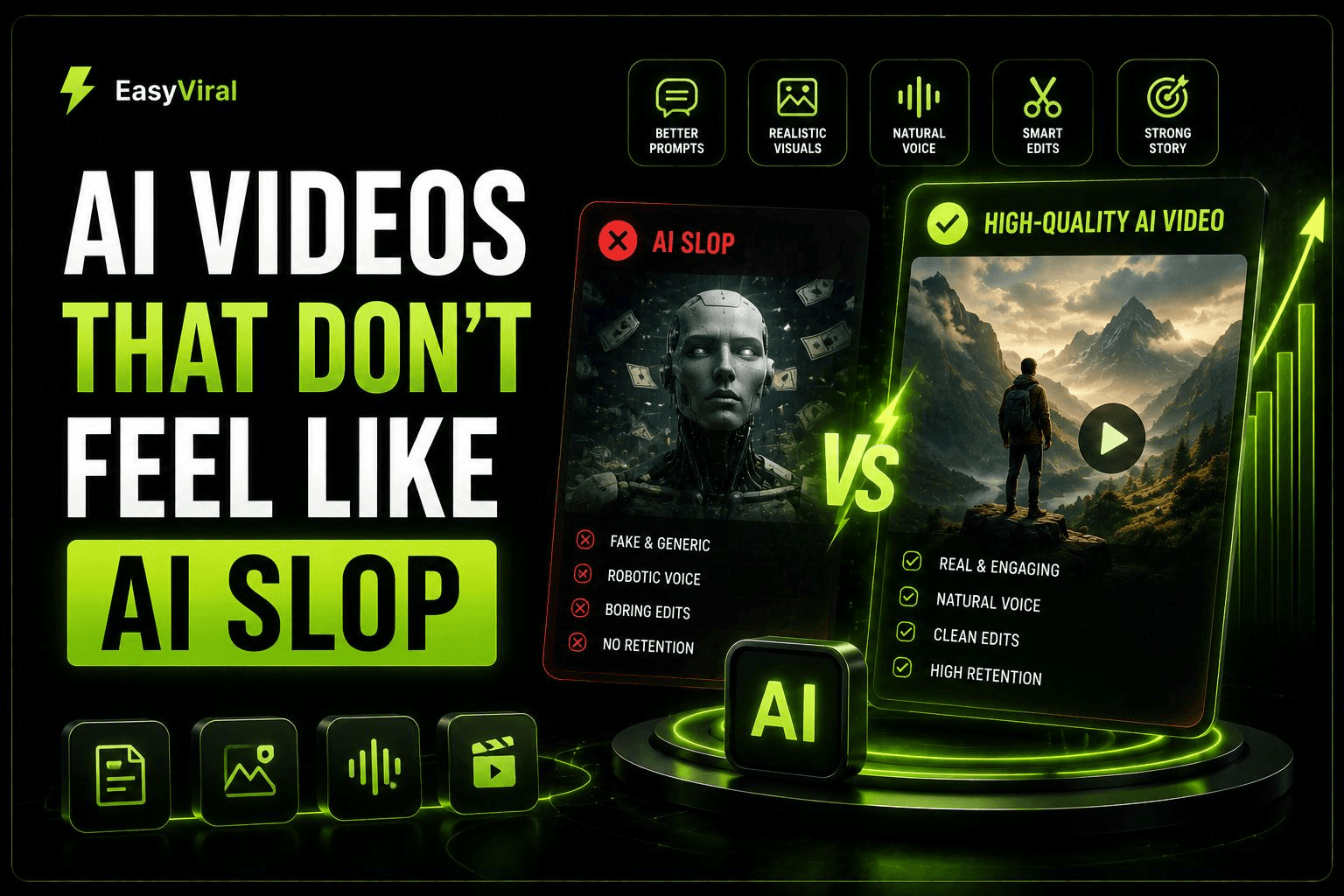
The pattern is almost always the same. A text-to-speech voice reads a script that was generated by a chatbot without editing. The visuals are generic stock footage or AI-generated images that don't connect to the narration in any meaningful way. The structure follows a rigid template: hook, list of points, call to action. There are no original examples, no personal perspective, no moments where a human clearly made a creative choice.
The result is content that feels hollow. It fills time without adding value. And once you notice the pattern, you start seeing it everywhere: in Shorts feeds, in recommended videos, in kids' content, in every niche from finance to fitness.
The most telling characteristic of AI slop isn't any single technical flaw. It's the total absence of a point of view. Slop doesn't argue anything. It doesn't take a position. It doesn't share an experience or offer an insight that required thought. It just... exists, occupying space in a feed without earning the attention it asks for.
Why viewers hate it
In Billion Dollar Boy's research across the UK and US, only 26% of consumers said they prefer AI-generated creator content in 2025, down from 60% in 2023. And in a 2025 Raptive study of 3,000 US adults, content people suspected was AI-generated was rated 48% less trustworthy, whether or not AI actually made it.
That last point matters. The problem isn't just actual AI slop. It's the suspicion of AI slop. Viewers have developed a hair trigger for anything that feels automated, and once they sense it, they disengage.
There are a few specific reasons this reaction is so strong.
The uncanny valley of content. Just as CGI faces that are almost-but-not-quite human make people uncomfortable, AI content that mimics the structure of real creator work without the substance triggers a similar unease. Something is off, even if the viewer can't immediately name what it is. The pacing feels mechanical. The voice lacks the micro-hesitations and tonal shifts of natural speech. The script hits all the expected beats without any surprises.
Repetition fatigue. When every AI-generated finance video opens with the same hook structure and covers the same surface-level points, viewers learn to recognize the template. They don't just skip that one video. They start skipping everything that resembles it. The format itself becomes a signal for low quality.
No reason to subscribe. People subscribe to channels because of a specific voice, perspective, or personality they connect with. AI slop channels offer none of that. Every video is interchangeable. There's no reason to come back for more when the next channel's bot-generated video covers the same ground in the same way.
Viewers feel disrespected. There's an implicit social contract between creator and audience: I put in effort, you give me your attention. AI slop breaks that contract. The viewer can tell that nobody cared about this video, and that realization doesn't just produce indifference. It produces resentment.
What YouTube's algorithm does about it
YouTube isn't just relying on viewer behavior to handle AI slop. It says it is building on the systems it already uses against spam, clickbait and repetitive content to reduce the spread of low-quality AI content.
In July 2025, YouTube renamed its "repetitious content" monetization policy to "inauthentic content," calling it a minor update to make clear that it covers repetitive or mass-produced content. Its current monetization policies list "AI-generated content made with generic or unoriginal templates giving the impression of mass production without adding the creator's original, authentic insights or perspective" as not allowed to monetize, along with videos that stitch together unrelated AI clips to shock viewers. Using AI to visualize a character and story you invented, or to edit your scripts, is explicitly allowed. Copied or re-uploaded videos fall under a separate reused content policy. Our guide to monetizing AI-generated videos on YouTube goes through each rule.
YouTube has not published how its systems detect AI content. It does say it may add an AI label itself when content was made with YouTube's own AI tools, carries C2PA metadata, or is detected by its internal systems as AI-generated or altered.
YouTube does not publish which signals trigger a review, so the safe assumption is that a channel full of template-made videos is exposed, even if each upload looks fine on its own.
The January 2026 removals were the most visible sign. For most creators the likelier cost is quieter: videos that viewers skip simply get recommended less, and the first sign is usually falling impressions in YouTube Analytics.
For the algorithm, trust is cumulative and fragile. A channel that earns a reputation for authentic content gets boosted over time. A channel that triggers inauthentic signals gets quietly buried.
The 8 differences between AI slop and quality AI-assisted content
AI slop and quality AI-assisted content often use the same tools. The difference is in how those tools are applied. Here are the eight areas where they diverge.
- 1Scripting. Slop takes the raw output from a chatbot and reads it as-is. Quality content uses AI to generate a first draft or outline, then rewrites it with specific examples, personal opinions, and a clear argument. The finished script should sound like something a specific person would say, not something any chatbot would produce.
- 2Voiceover. Slop uses a stock text-to-speech voice with no customization, the same voice heard on thousands of other channels. Quality content either uses a custom-trained AI voice with natural pacing and personality, or records real narration and uses AI only for cleanup and enhancement. The voice should feel like it belongs to the channel, not to a software library.
- 3Visuals. Slop runs generic stock footage or AI-generated images that have no specific connection to the script. Quality content uses visuals that were selected or created for this specific video, with intentional framing, color grading, and composition that support the narrative. Even if visuals are AI-generated, they should feel curated rather than random.
- 4Editing. Slop strings clips together with minimal cuts, no rhythm, and no visual variety. Quality content has deliberate pacing: moments of intensity followed by breathing room, visual emphasis on key points, transitions that serve the story rather than just filling gaps.
- 5Pacing. Slop moves at a constant speed from start to finish with no variation. Quality content controls tempo. It slows down for important moments and speeds up through supporting material. The viewer's attention is managed, not assumed.
- 6Hooks. Slop uses templated hooks that sound like every other video in the niche. Quality content opens with a specific, unexpected, or provocative statement that could only belong to this video. The hook should make a promise that the rest of the video actually delivers on.
- 7Research depth. Slop repeats the first page of search results. Quality content goes deeper: citing specific data, referencing less obvious sources, connecting ideas in ways that require actual thought. The viewer should learn something they couldn't have gotten from a five-second search.
- 8Personal perspective. This is the biggest one. Slop has no point of view. Quality content takes a position, shares an experience, or offers an opinion that came from a human brain. It doesn't have to be controversial. It just has to be real. A video about investing should reflect what the creator actually thinks about investing, not what a chatbot says the average person thinks.
The quality checklist: 7 checks before you publish
Before any video goes live, run it through these questions. If you can't answer "yes" to most of them, the video probably feels like slop, even if you didn't intend it to.
- 1Could this script have been written by anyone? If there's nothing in the script that reflects a specific perspective, experience, or opinion, rewrite it. Add a take. Make an argument. Reference something specific that a chatbot wouldn't know to include.
- 2Does the voiceover have personality? Listen to the first 15 seconds. Does it sound like a person talking, or like a machine reading? If it's the latter, adjust the pacing, add emphasis on key words, or re-record the sections that sound flat.
- 3Do the visuals match the specific points being made? Pause the video at any random moment. Do the visuals on screen relate to what's being said right now, or are they just atmospheric filler? Every visual should earn its place.
- 4Is there at least one moment that surprises the viewer? Predictable content is forgettable content. A surprising statistic, an unexpected comparison, a counterintuitive argument. There should be at least one moment where the viewer thinks, "I didn't know that" or "I hadn't thought about it that way."
- 5Would you watch this? Honestly. If this video showed up in your own feed from a channel you'd never seen before, would you watch it for more than 10 seconds? If the answer is no, figure out why and fix it.
- 6Does the video earn its length? If you could cut 30% of the content without losing anything important, the video is padded. Tighten it. Viewers can feel when a video is stretching to hit a runtime target.
- 7Is the upload frequency sustainable at this quality? Posting three videos a day with declining quality is worse than posting three videos a week with consistent quality. YouTube's monetization policies target content that gives the impression of mass production, and a high upload rate of thin, similar videos looks exactly like that. Find a pace where every video meets your standard.
Why this matters for your channel's long-term survival
The temptation with AI tools is to optimize for volume. The tools make production fast, so the logic goes: more videos means more chances to go viral, which means more revenue. In 2024, that logic worked for some channels. In 2026, it's a trap.
Three forces are converging to make quality the only sustainable strategy.
Algorithm trust is earned over months and lost in days. YouTube's recommendation system builds a trust profile for every channel based on viewer behavior signals: watch time, return viewers, engagement rates, and audience retention patterns. Channels that consistently produce content viewers actually watch build algorithmic momentum. Channels that produce content viewers skip, click away from, or ignore lose that momentum. One batch of low-effort uploads can undo months of positive signals.
Audience loyalty requires a reason to exist. The channels that survive platform shifts are the ones with audiences who would notice if they disappeared. That kind of loyalty comes from personality, perspective, and consistent quality. It doesn't come from volume. A viewer who subscribes because one video was useful will unsubscribe the moment they realize every video is the same template with different keywords plugged in.
Advertiser confidence follows content quality. Channels that break these monetization policies are not eligible for the YouTube Partner Program. And perception costs advertisers too: in the same Raptive study, ads shown next to content people believed was AI-made saw a 14% drop in purchase consideration. The revenue math that made slop profitable in 2024 doesn't hold up anymore.
The creators who will thrive in the next phase of YouTube are the ones who treat AI as a production assistant, not a replacement for creative thought. Use it to work faster. Use it to handle the tedious parts of production. But keep the thinking, the opinions, and the creative decisions in human hands.
Frequently Asked Questions
What is AI slop?
AI slop is low-quality content mass-produced with AI and little human input. Merriam-Webster named "slop" its 2025 Word of the Year and defines it as digital content of low quality that is produced usually in quantity by means of artificial intelligence. On YouTube it usually means unedited chatbot scripts, stock text-to-speech voices and visuals that don't match the narration.
Does YouTube demonetize AI-generated videos?
Not for using AI alone. YouTube's monetization policies explicitly allow using AI to visualize a character and story you invented or to edit your scripts. What they rule out is AI-generated content made with generic or unoriginal templates that gives the impression of mass production without the creator's own insight, and videos that stitch together unrelated AI clips to shock viewers. The risk is sameness, not the tool.
Do you have to label AI-generated videos on YouTube?
Only when the content is realistic and could mislead: making a real person appear to say or do something they didn't, altering footage of a real event or place, generating a realistic scene that didn't happen, or AI music that is the main focus. Animation, AI-assisted scripts and captions don't need it, and disclosing alone won't limit reach or eligibility to earn money.
How do you make AI voiceovers sound less robotic?
Pick a voice that fits your channel and keep it consistent, then edit for delivery: add emphasis on key words, vary the pace between important moments and supporting detail, and re-render or re-record lines that sound flat. Listen to the first 15 seconds as a viewer would. If it sounds like a machine reading, viewers will hear it too.
Can AI video tools help you avoid AI slop?
They can handle the labor, but not the judgment. Tools like EasyViral write, voice, render and auto-post videos, which frees time for what makes content worth watching: a real argument, specific examples, careful topic choice and variety between uploads. Slop comes from skipping those decisions, whichever tool you use.