YouTube Shorts vs TikTok vs Reels: Where Faceless Creators Should Post First in 2026
On this page
- How Each Platform's Algorithm Works (And Why It Matters for Faceless Creators)
- Monetization Head-to-Head: Who Pays Faceless Creators the Most?
- Content Shelf Life: Where Your Videos Keep Working After Day One
- Which Platform Suits Faceless Content Best?
- The Cross-Posting Strategy (Do Not Just Re-Upload the Same File)
- The Verdict: Where Should Faceless Creators Start?
- Frequently Asked Questions
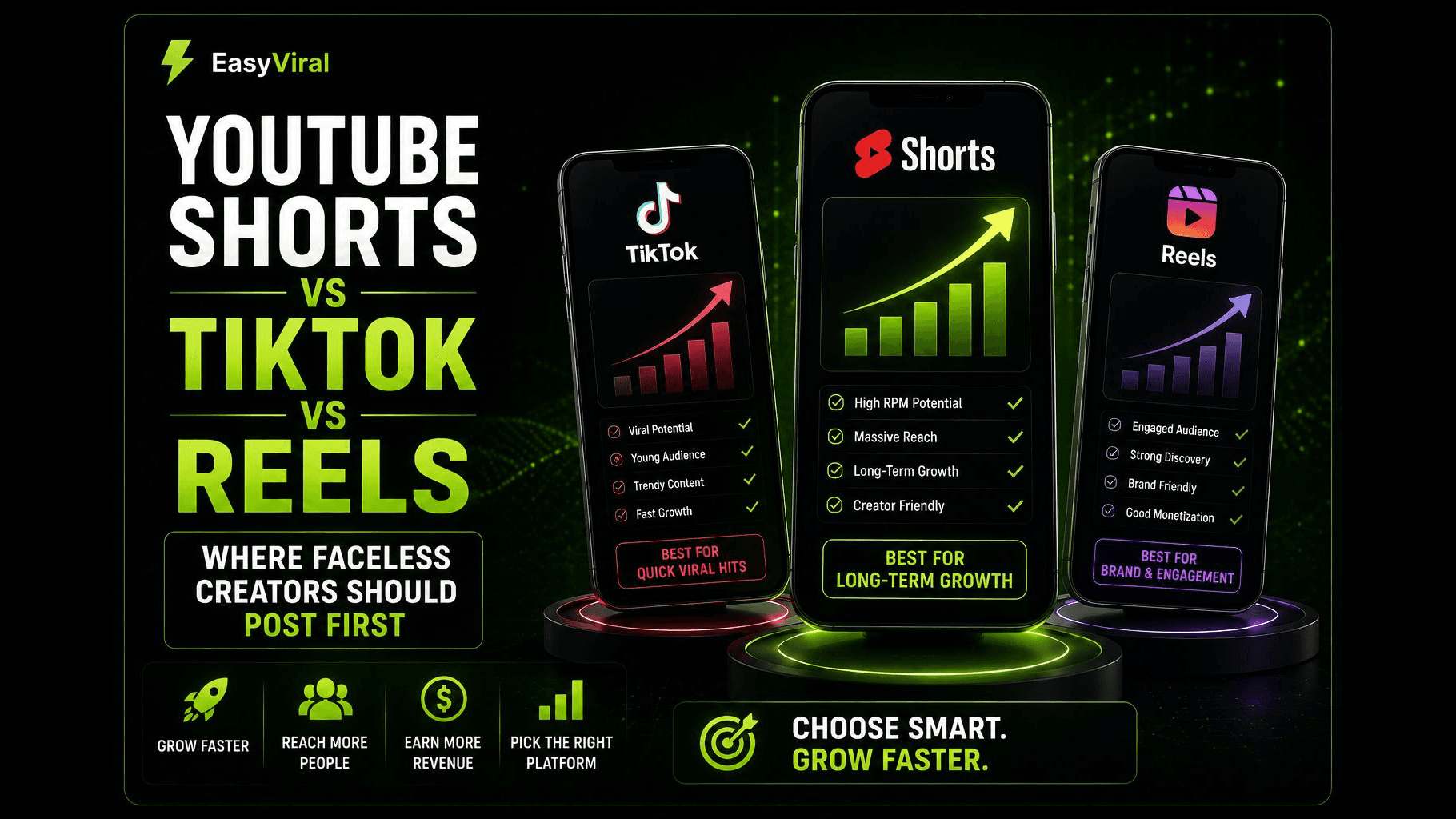
Most faceless creators should post to YouTube Shorts first, add TikTok second and Instagram Reels third. Shorts are searchable, can keep earning views for months and feed viewers into long-form videos. TikTok gives the fastest feedback but pays only for videos of at least one minute. Instagram pays for Reels views only through invitation-only bonuses for very large accounts. Tools like EasyViral can auto-post one video to all three.
All three platforms can work. But "can work" is not a strategy. Each platform has a different algorithm, a different monetization model, a different content shelf life, and a different audience. Posting the same video to all three without understanding those differences is how creators burn months without gaining traction anywhere.
This guide breaks down how YouTube Shorts, TikTok, and Instagram Reels compare in 2026 for faceless creators. Where to start, where to expand, and how to cross-post without tanking your reach.
How Each Platform's Algorithm Works (And Why It Matters for Faceless Creators)
The algorithm is the gatekeeper. It decides who sees your content, how quickly it spreads, and whether your video dies at 200 views or reaches 200,000. Each platform takes a fundamentally different approach.
TikTok: Pure Interest Graph
TikTok's algorithm is the most aggressive at pushing content to strangers. TikTok says its For You feed is driven mainly by how viewers interact with videos (likes, shares, comments, and whether they watch in full or skip), plus content details such as sounds and hashtags and viewer settings such as language and location.
The key detail: TikTok says neither follower count nor an account's past hits are direct factors in its recommendation system, so a new account can break out, although accounts with more followers still tend to get more views. Each video is judged largely on how viewers respond to it.
For faceless creators, this is a double-edged sword. Maximum discovery potential, but zero loyalty bonus. Every video starts from scratch.
YouTube Shorts: Hybrid Interest + Subscriber Model
YouTube Shorts sits in the middle. The Shorts shelf surfaces content to non-subscribers based on interest signals, similar to TikTok. But YouTube also factors in channel authority, topic consistency, viewer watch history, and your existing subscriber base.
Here is what makes Shorts different: viewers who find you in the Shorts feed can subscribe and then see your long-form videos, so Shorts can feed the rest of your channel. Our guide to how the Shorts algorithm works covers the ranking side.
For faceless creators, this hybrid model is powerful. It means you can build compounding growth. Early Shorts help you gain subscribers, and those subscribers boost the reach of future Shorts. TikTok says follower count is not a direct factor in its For You recommendations.
Instagram Reels: A Discovery Feed With Originality Rules
Instagram says Reels is built for discovery: most reels people see there come from accounts they don't follow. It ranks reels mainly on how likely a viewer is to reshare, watch to the end, like, or open the audio page.
For faceless creators, that means a new account can reach non-followers, but Instagram makes reels less visible when they are watermarked, low-resolution, mostly text, or already posted on Instagram. Reels works best as a second or third platform once you have built an audience elsewhere.
The Core Difference
TikTok optimizes for time spent on the app. YouTube optimizes for subscriber conversion. Instagram optimizes for ecosystem engagement. Each priority shapes what content gets pushed and to whom.
Monetization Head-to-Head: Who Pays Faceless Creators the Most?
Let's talk money. This is where the platforms diverge sharply.
YouTube Shorts: Slow but Steady
YouTube Shorts monetization uses an ad revenue pool model. Ads that appear between Shorts feed into a regional revenue pool. That pool gets divided among creators based on their share of total Shorts views in that region, minus a cut for music licensing if your Shorts use copyrighted audio.
The numbers: YouTube publishes no typical Shorts RPM, and what creators report varies widely, so check your own in YouTube Analytics. Creators keep 45% of their allocated share. From February 1, 2027, a channel earns from the Shorts Creator Pool only in months when it has 10 million qualified Shorts views over the last 90 days (what changes in 2027).
Shorts ad revenue is small if you treat Shorts as your only income source. The real value is indirect: Shorts can drive subscribers to your channel, where long-form videos can earn a much higher RPM.
For faceless creators, this funnel is everything. A single Short that pushes 500 new subscribers to your channel can generate far more long-term revenue through long-form watch time than the Short itself ever earns directly.
TikTok: Higher Per-View Rates, Stricter Requirements
TikTok phased out its original Creator Fund and replaced it with the Creator Rewards Program. To join, you need to be 18 or older, have at least 10,000 followers and at least 100,000 video views in the last 30 days, and live in an eligible country. Rewards are calculated from qualified views and a rate per 1,000 qualified views that TikTok does not publish.
The catch: only original videos at least one minute long qualify, and only unique For You feed views watched for more than 5 seconds count as "qualified views." Each video needs at least 1,000 of them before it earns anything. So your 15-second viral clip with 10 million views? It earns nothing through Creator Rewards.
For faceless creators, this changes the content strategy. You need to create TikToks that are at least 60 seconds long and compelling enough to hold attention past the five-second mark. Quick-cut compilations and 10-second clips will not generate direct revenue on TikTok, no matter how many views they pull.
TikTok does not publish what a million qualified views pays, so treat third-party RPM estimates with caution. And TikTok offers no long-form funnel equivalent. What you earn per video is what you get.
Instagram Reels: Invite-Only and Inconsistent
Instagram's creator site lists no ad revenue share for Reels. Its earning options are subscriptions, gifts, badges, partnership ads, the creator marketplace and bonuses. The bonus for reels is a limited-time, invitation-only test that requires at least 5 million views within the previous three consecutive calendar months and is only available in the US and South Korea.
The problem: the Bonus program is invite-only. Even creators who meet the view minimum are not all selected. If you are not in the program, your Reels earn nothing directly.
Instagram does not publish typical bonus payouts, and the 5 million view minimum puts the reels bonus out of reach for new accounts. A new faceless creator should not count on Reels for direct revenue.
The Monetization Verdict
TikTok's Creator Rewards Program pays per qualified view on videos of at least one minute, but neither TikTok nor YouTube publishes per-view rates, so no one can say for certain which pays more per view. For total earnings potential, YouTube offers the most routes because Shorts can feed a long-form channel. Instagram Reels monetization is too inconsistent and access-restricted to build a strategy around.
Content Shelf Life: Where Your Videos Keep Working After Day One
This is one of the most underrated differences between the three platforms, and it matters enormously for faceless creators who want to build assets rather than chase trends.
YouTube Shorts: Weeks, Months, Sometimes Years
YouTube Shorts benefit from search: they show up in YouTube search results alongside regular videos. A Short that answers a common question ("What is compound interest?" or "How does VPN encryption work?") can continue generating views for months or even years through search results and recommendations.
This matters most for faceless creators in evergreen niches. A finance explainer or tech tutorial does not expire. You are building a library of content that compounds over time, with each new Short adding another entry point to your channel.
TikTok: A Short Window of Attention
TikTok content follows a boom-or-bust pattern. A video tends to either catch momentum in its first days or fade. There are occasional exceptions where a video resurfaces weeks later, but the norm is a very short window of relevance.
This means TikTok rewards volume and recency. You need to post frequently to stay visible. If you take a week off, your previous content is not working for you the way a YouTube library would be.
For faceless creators, this is the biggest downside of TikTok. Every video is essentially disposable. You are renting attention, not building an asset.
Instagram Reels: A Few Days, Then Gradual Decline
Reels fall between the two extremes. Most of a Reel's engagement tends to come in its first few days, though strong Reels can keep picking up views through Explore. Search discovery is weaker than on YouTube, but search engines like Google and Bing can now index public reels from professional accounts whose owners are over 18, unless the account turns this off.
Why Shelf Life Matters for Faceless Creators
If you are a solo creator (or using AI tools to produce content), you want every video to keep generating returns long after you publish it. YouTube Shorts is the only platform where that consistently happens. A library of 100 Shorts on YouTube is an asset. A library of 100 TikToks is a history log.
Which Platform Suits Faceless Content Best?
Faceless content has its own set of challenges on each platform. AI content policies, watermark detection, and format requirements all vary.
AI Content Policies in 2026
All three platforms require you to disclose realistic AI-generated content, but the rules and consequences differ.
YouTube requires creators to disclose realistic altered or synthetic content, such as a real person saying something they didn't or a realistic scene that never happened, and disclosure alone does not limit reach or monetization. AI-made videos can earn through the Partner Program, but in July 2025 YouTube renamed its repetitious content policy to "inauthentic content" to make clear it covers mass-produced, repetitive videos. Faceless channels are not banned. Low-effort, templated faceless channels are what gets flagged.
TikTok requires creators to label AI-generated content that contains realistic images, audio or video. It may also auto-label content made with its AI effects or carrying C2PA Content Credentials, and an auto label can't be removed. TikTok says it may remove unlabeled AI-generated content that violates its Community Guidelines.
Meta requires people to use its disclosure tool when they post photorealistic video or realistic-sounding audio that was digitally created or altered, and says it may apply penalties if they don't. Since July 2024 the label reads "AI info" rather than "Made with AI."
For faceless creators using AI tools: label realistic AI content whenever the rules require it, and when in doubt, label it. The platforms are not punishing AI content. They are punishing undisclosed AI content.
Watermark Detection
Instagram openly reduces the reach of reels carrying watermarks from other apps. This matters because many faceless creators cross-post.
Instagram says it aims to make watermarked reels less visible and is less likely to recommend content with noticeable watermarks. YouTube has not published an equivalent rule for Shorts, but there is no upside in risking it.
The fix is simple: always export clean versions from your editing software before posting to any platform. Never download from one platform and upload to another with the watermark still attached.
Format Fit for Faceless Content
YouTube Shorts can be up to 3 minutes long in a square or vertical format. The search integration makes it ideal for educational and informational faceless content. TikTok supports videos up to 10 minutes, though the Creator Rewards sweet spot is 1 to 3 minutes with faster pacing expected. Instagram Reels can run up to 20 minutes, but Instagram says reels over 3 minutes won't be recommended to new audiences.
The Cross-Posting Strategy (Do Not Just Re-Upload the Same File)
Cross-posting is smart. Re-uploading the same file to three platforms is not.
Each platform has different caption cultures, hashtag strategies, and audience expectations. A caption that works on TikTok (casual, trend-referencing) will feel out of place on YouTube (keyword-optimized, search-friendly). Here is how to cross-post effectively.
Step 1: Create From Your Master File
Edit your video in your editing software, or generate it with an AI tool like EasyViral (no watermark on any plan), and export a clean, watermark-free master file. This is your source of truth.
Step 2: Customize for Each Platform
For YouTube Shorts: write a keyword-rich title (this is searchable). Add 3 to 5 relevant hashtags. Include a description that naturally incorporates search terms. Think about what someone might type into YouTube search to find this video.
For TikTok: write a conversational caption. Use trending sounds if they fit, but remember that Creator Rewards excludes videos where copyrighted music or lip sync plays for over a minute. Add relevant hashtags, including a mix of broad and niche tags. If the video is under 60 seconds, know that it will not earn through Creator Rewards.
For Instagram Reels: write a concise, visually clean caption. Use up to 5 hashtags, which is now Instagram's limit per post or reel. Use the AI disclosure (shown as "AI info") if the reel contains photorealistic AI video or realistic AI audio. Make sure your cover image is strong, as it lives on your grid.
Step 3: Post Natively
Upload a clean file to each platform, either directly or through a scheduler that publishes without adding watermarks, such as EasyViral's auto-posting for the videos it creates. Each upload should feel native to the platform it lives on.
Step 4: Stagger Your Posting Times
Stagger by a few hours or even a day. This lets you monitor early performance on your primary platform before the other uploads go live.
The Verdict: Where Should Faceless Creators Start?
Here is the recommendation, ranked by priority.
Start with YouTube Shorts
YouTube Shorts should be your primary platform for three reasons. First, monetization with long-form upside. Shorts RPM alone is modest, but the subscriber funnel into long-form content creates the highest total earning potential of any platform. Second, content shelf life. Your Shorts keep working for weeks and months through search and recommendations. You are building a library, not a feed. Third, the algorithm rewards consistency. The hybrid interest-plus-subscriber model means your growth compounds over time in a way that TikTok's pure interest graph does not allow.
Add TikTok for Discovery
Once you have a consistent publishing rhythm on YouTube, add TikTok. TikTok's pure interest graph gives you the fastest path to viral reach, and the Creator Rewards Program pays for qualified views on videos of at least one minute. Use TikTok to test which topics resonate (the fast feedback loop is valuable) and to drive awareness that you can convert into YouTube subscribers.
Expand to Instagram Reels for Audience Diversification
Add Reels once you have traction on at least one other platform. Instagram's Reels feed mostly shows accounts people don't follow, so a new account can reach strangers, and once you have content that is proven to perform on Shorts and TikTok, adapting it for Reels gives you a third audience stream. If the Bonus program invites you in, the extra revenue is a nice addition.
The One-Platform Answer
If you can only pick one platform and you are building a faceless channel in 2026, pick YouTube Shorts. The combination of monetization, search-driven shelf life, and the long-form content funnel makes it the strongest foundation for a sustainable faceless content business.
No other platform lets your old content keep earning while your new content drives growth.
Frequently Asked Questions
Which platform should faceless creators post on first?
YouTube Shorts, for most faceless channels. Shorts are searchable, can keep earning views long after posting, and can send viewers to your long-form videos. Add TikTok next for fast feedback and Creator Rewards on videos of at least one minute, and Instagram Reels third, once you have content that has already proven itself elsewhere.
How does the TikTok Creator Rewards Program work?
You need to be 18 or older, have at least 10,000 followers and 100,000 video views in the last 30 days, and live in an eligible country. Only original videos at least one minute long earn, and only unique For You feed views watched for more than 5 seconds count as qualified. Each video needs 1,000 qualified views before it starts earning.
Does Instagram pay creators for Reels views?
Only through bonuses, and only by invitation. Instagram is testing a limited-time bonus for reels that requires at least 5 million views within the previous three consecutive months and is only available in the US and South Korea; even qualifying creators are not all invited. Otherwise, Instagram's earning tools are subscriptions, gifts, badges, partnership ads and the creator marketplace.
Can I post the same faceless video on Shorts, TikTok and Reels?
Yes, but upload a clean file to each platform rather than downloading from one and re-uploading. Instagram says it is less likely to recommend reels with noticeable watermarks from other apps. Write captions for each platform: keyword-rich titles on YouTube, conversational captions on TikTok, and no more than 5 hashtags on Instagram, which is now its limit.
Do I need to label AI-generated videos on TikTok, YouTube and Instagram?
Yes, when the content is realistic. TikTok requires labels on AI-generated content with realistic images, audio or video. YouTube requires disclosure for realistic altered or synthetic content, such as a real person saying something they didn't. Meta requires disclosure for photorealistic video or realistic-sounding audio and shows an "AI info" label. Clearly unrealistic content, like animation, generally doesn't need one.