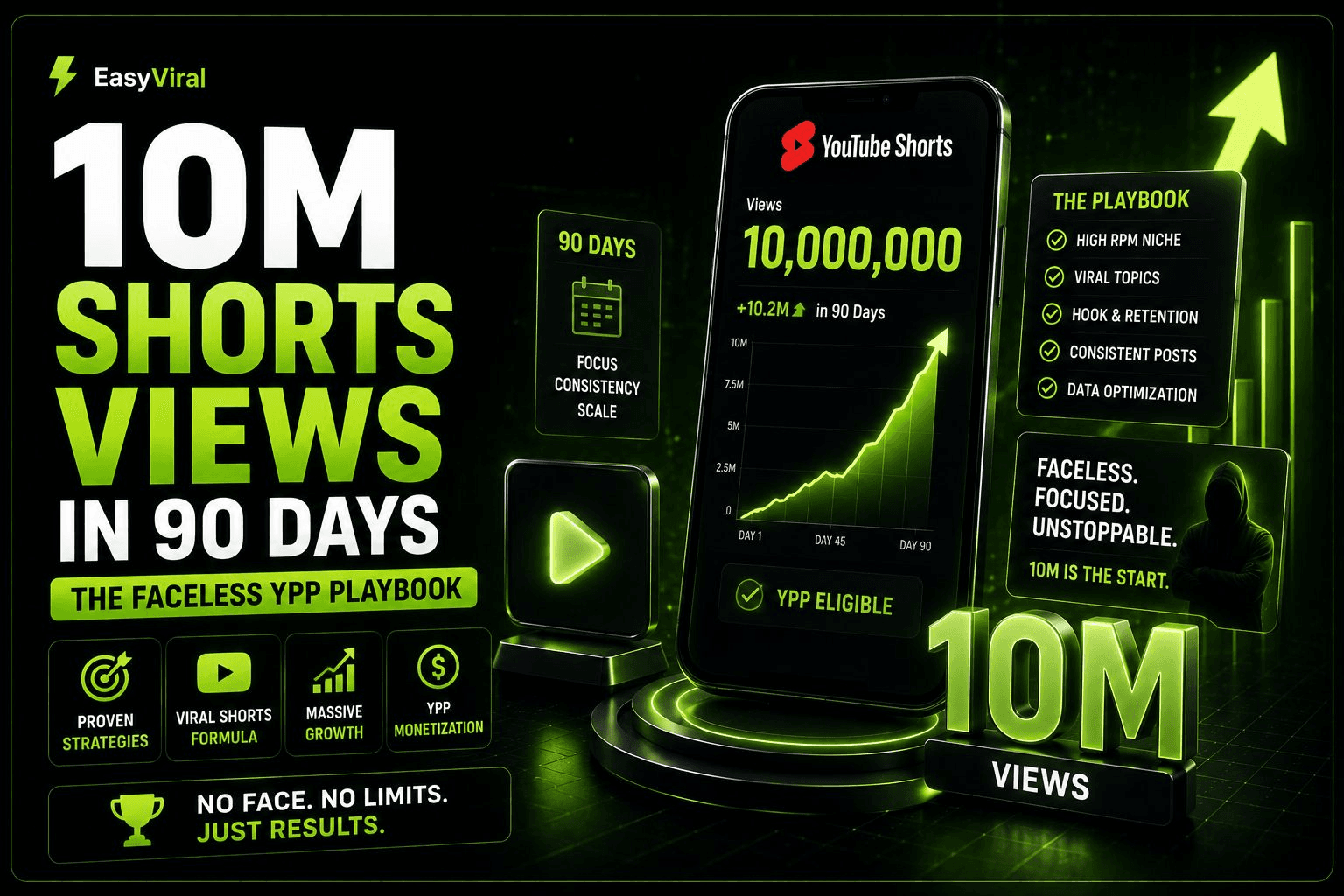
How to Hit 10 Million Shorts Views in 90 Days: The Faceless Creator's YPP Playbook
On this page
- The two paths to YPP (and why Shorts is faster for faceless creators)
- The math breakdown: how many videos at what view count
- The content strategy: which niches and formats drive the highest Shorts view volume
- The posting playbook: frequency, timing, and distribution
- What happens after you hit 10 million views
- Common mistakes that reset (or waste) your 90-day window
- The 90-day sprint is a system, not a gamble
- Frequently Asked Questions
Hitting 10 million Shorts views in 90 days means averaging about 111,000 qualified views a day. Faceless channels get there through volume and consistency: post Shorts every day in one high-interest niche, open each one with the payoff in the first second, ride trends when they appear, and never let the rolling 90-day window go quiet. Breakout videos are a bonus on top of that steady base.
Update (October 2026): YouTube changes these rules on February 1, 2027. New YPP applicants will need 1,000 subscribers plus 8,000 qualified watch hours in 365 days or 20 million qualified Shorts views in 90 days (today it is 4,000 hours or 10 million views). Channels already in YPP keep their status. From that date, 10 million qualified Shorts views over the last 90 days is also the monthly bar to earn from the Shorts Creator Pool; missing it does not remove you from YPP or touch other earnings. Sources: YouTube Help and our guide to the 2027 YPP changes.
10,000,000 views divided by 90 days = 111,111 views per day.
If you post 2 Shorts per day, each one needs to average about 55,500 views. If you post 3, the per-video average drops to 37,000. And if just 1 in every 10 of your Shorts picks up 500,000+ views, you could reach the threshold before day 90.
The math is aggressive but achievable. YouTube does not publish how many channels clear this bar through the Shorts monetization pathway, so treat what follows as a system to test, not a promise.
The two paths to YPP (and why Shorts is faster for faceless creators)
YouTube offers two routes into the Partner Program for full ad revenue access:
Path 1: Long-form. 1,000 subscribers + 4,000 qualified public watch hours in the past 12 months. For applications from February 1, 2027, this rises to 8,000 qualified watch hours in the past 365 days.
Path 2: Shorts. 1,000 subscribers + 10 million qualified public Shorts views in the past 90 days. For applications from February 1, 2027, this rises to 20 million qualified Shorts views in 90 days.
The paths are completely separate. Watch time from Shorts in the Shorts feed does not count toward the watch hour requirement, and long-form watch hours do not count toward the 10 million Shorts views. You need to fully complete one path or the other.
For faceless creators, the Shorts path is almost always faster. Here is why.
Long-form content requires scripting, editing, and producing videos that hold attention for 8-15 minutes. Each video takes hours to create. A faceless channel posting 2-3 long-form videos per week can take many months to build enough watch hours, even when the content performs well.
Shorts take 15-45 seconds. A faceless creator using AI tools can produce and schedule 2-3 per day. The sheer volume of content means more chances at the algorithm, more chances for a video to go viral, and a dramatically compressed timeline to monetization. How long it takes varies widely with niche, hook quality and consistency, and YouTube publishes no typical timeline.
There is also a lower-tier YPP option worth knowing about: 500 subscribers and 3 valid public uploads in the last 90 days, plus either 3 million qualified Shorts views in the last 90 days or 3,000 qualified watch hours in the last 12 months. It opens fan funding (channel memberships, Super Chat, Super Stickers, Super Thanks) and Shopping, and YouTube says these thresholds stay the same after February 2027. It does not include ad revenue, but it gives you an early income stream while you push toward the full threshold.
The math breakdown: how many videos at what view count
Let's get specific. The numbers below assume a 90-day window and different posting frequencies.
Scenario 1: 2 Shorts per day, consistent performance. 180 total Shorts. Each needs to average 55,556 views. This is a solid middle ground. Treat a steady 55K average as a target to test against your own analytics, not a typical result, even in high-volume niches like satisfying content, facts and motivation.
Scenario 2: 3 Shorts per day, consistent performance. 270 total Shorts. Each needs to average 37,037 views. Easier per-video target, but maintaining quality across 3 daily uploads is the challenge. This is where AI-powered creation tools become essential rather than optional.
Scenario 3: 2 Shorts per day with viral spikes. Here most Shorts land in a moderate range and a few break out far above it. In the example below, about 1 in 7 Shorts pulls 150,000 views or more, and those spikes do the heavy lifting.
Here is an example breakdown for Scenario 3:
- 150 Shorts averaging 30,000 views = 4,500,000 views
- 20 Shorts averaging 150,000 views = 3,000,000 views
- 5 Shorts averaging 500,000+ views = 2,500,000+ views
- Total: 10,000,000+ views
In that example, the top 25 Shorts (about 14% of uploads) bring in 55% of the views. You do not need every video to go viral. You need a consistent base with periodic breakouts.
The subscriber piece. You also need 1,000 subscribers. How many viewers subscribe from Shorts varies widely, and YouTube publishes no typical ratio, so track subscribers gained per Short in YouTube Analytics from the first week (Mistake 6 below covers channels that fall short).
The content strategy: which niches and formats drive the highest Shorts view volume
Not all niches are created equal for Shorts velocity. The goal here is not just high CPM. It is high view volume. Some niches pay well per view but rarely go viral. For hitting 10 million views fast, you want niches where individual Shorts routinely clear 100K+ views.
Highest-volume faceless Shorts niches (2026)
- 1Satisfying/oddly satisfying content. Cleaning, organizing, slime, kinetic sand. These consistently pull massive view counts because they trigger compulsive rewatching.
- 2Quick facts and "did you know" content. History facts, science facts, psychology facts. The format is simple (text overlay + stock footage + voiceover), production is fast, and the replay rate is high.
- 3Motivational/stoic content. Quote-based Shorts with cinematic backgrounds. High volume, high share rate. The format lends itself to batch production.
- 4Before/after transformations. Room makeovers, art progressions, fitness transformations. The reveal structure keeps swipe-away rates low.
- 5AI and tech tutorials. Quick how-to clips about AI tools, apps, and productivity hacks. Growing fast as a niche with strong engagement signals.
- 6Food and recipe clips. Overhead shot recipes, street food compilations, "making the most expensive sandwich" style content. Extremely high view potential.
- 7Gaming highlights and clips. Funny moments, clutch plays, speedrun segments. Enormous built-in audience.
Hook optimization
The first 1-2 seconds of a Short determine whether the viewer swipes away or stays. For faceless creators, this means:
- Open with the most surprising or curiosity-triggering frame. Not the setup. The payoff tease.
- Use text hooks on screen within the first half-second. "This country doesn't exist anymore." "Scientists can't explain this." "You've been doing this wrong."
- Avoid slow intros, logos, or channel branding at the start. Every millisecond of non-compelling content in the opening increases your swipe-away rate.
- Match the hook to trending search queries. Use YouTube's search suggest feature and Google Trends to find what people are actively looking for right now.
Riding trending topics
Channels that hit 10 million views fastest are not just publishing evergreen content. They layer in trending topics. When a news story, meme, or cultural moment is spiking, creating 2-3 Shorts around that topic within 12-24 hours gives you a chance to ride the search and recommendation wave.
A simple starting point is mostly evergreen content in your niche plus a smaller share of trend-reactive Shorts, adjusted to what your analytics show. The evergreen base builds your channel's topical authority. The trend-reactive content creates the viral spikes that accelerate your view count.
The posting playbook: frequency, timing, and distribution
Posting frequency
More Shorts at consistent quality give you more chances at a breakout. The sweet spot for channels targeting 10 million views in 90 days is 2-3 Shorts per day. Some creators push to 4-5, but the quality trade-off usually is not worth it unless production is fully automated.
Here is why frequency matters beyond just math. Every Short you post is a new lottery ticket in the algorithm. The more tickets you hold, the higher your probability of a breakout. Channels posting once a day have fewer shots at going viral than channels posting three times a day. Over 90 days, that difference compounds significantly.
Timing
YouTube's algorithm cares less about exact upload time than it did for long-form content, because Shorts are served primarily through the Shorts feed rather than subscription notifications. That said, posting when your target audience is most active gives your Short the best initial test audience. Use YouTube Analytics to see when your own viewers are on YouTube instead of relying on generic posting times.
Hashtags and metadata
Keep it simple. Use 3-5 relevant hashtags per Short. #Shorts is optional: YouTube classifies any video up to 3 minutes long with a square or vertical aspect ratio as a Short. Add 2-3 niche-specific tags. Your title should be descriptive and keyword-rich, not clickbait. YouTube's algorithm reads titles and descriptions to understand what your Short is about and who to show it to.
Cross-promotion
Do not rely solely on the Shorts feed. Repurpose your best-performing Shorts to TikTok, Instagram Reels, and Facebook Reels. The cross-platform presence can send some viewers back to your YouTube channel. It also helps you identify which content resonates most, so you can double down on those formats on YouTube.
What happens after you hit 10 million views
You have hit 1,000 subscribers and 10 million Shorts views within the 90-day window. Here is the process from application to first payout.
The application
Once you meet the thresholds, YouTube Studio will display a notification that you are eligible to apply. You need to: accept the YPP terms, sign up for Google AdSense (or link an existing account), and enable 2-Step Verification on your Google account. Your channel also needs zero active Community Guidelines strikes and access to advanced features, and you must live in a country or region where YPP is available.
The review
YouTube reviews your channel for policy compliance. YouTube says decisions typically arrive in about a month, and can take longer when application volume is high. They are checking that your content is original, does not violate advertiser-friendly guidelines, and that your channel is not built on reused content without meaningful transformation.
For faceless creators, the "meaningful transformation" piece is important. Channels that simply repost other people's clips or compile content without adding commentary, narration, or a unique editorial angle are more likely to be rejected. AI-generated content is allowed, but YouTube's monetization policies rule out AI-generated content made with generic or unoriginal templates that gives the impression of mass production without the creator's own insight or perspective.
How Shorts monetization works
Once approved, Shorts revenue works differently from long-form ad revenue. YouTube pools all ad revenue generated from ads shown between Shorts in the Shorts feed. That pool is then divided among creators based on their share of total Shorts views. From the creator's allocated portion, YouTube takes 55% and the creator keeps 45%. If your Short uses licensed music, a portion of the revenue goes to music rights holders before the creator split. From February 1, 2027, a channel earns from the Shorts Creator Pool only in months when it has at least 10 million qualified Shorts views over the last 90 days.
In practice, this means Shorts RPM (revenue per thousand views) is significantly lower than long-form. YouTube does not publish typical Shorts RPMs, so check your own in YouTube Analytics before you plan around Shorts ad revenue.
The real money is in what those views unlock: channel memberships, Super Thanks, affiliate marketing in descriptions, sponsored content deals, and driving traffic to your own products or services. The Shorts ad revenue is a baseline, not the ceiling.
Common mistakes that reset (or waste) your 90-day window
The 90-day Shorts view requirement uses a rolling window. It is not a fixed period. Every day, YouTube looks at the total public Shorts views from the previous 90 days. Views from day 91 and beyond drop off. This creates several traps that stall or reverse your progress.
Mistake 1: Starting strong, then going inconsistent
If you post aggressively for 30 days and then take 2 weeks off, your earliest views start falling out of the window while no new views are coming in. By the time you resume posting, you may have lost millions of views from the count. Consistency across the full 90 days (and beyond) is non-negotiable.
Mistake 2: Ignoring watch-through rate
Chasing views by posting sensationalized or misleading hooks might spike your view count short-term, but if viewers are swiping away after 2 seconds, the algorithm learns to suppress your content. A lower swipe-away rate on fewer Shorts will outperform a high swipe-away rate on many Shorts over 90 days.
Mistake 3: Posting content that violates Community Guidelines
An active Community Guidelines strike blocks a YPP application, regardless of your view count, until it expires 90 days after it was issued. Keep the related risks separate: unlicensed music leads to copyright claims or copyright strikes, which follow different rules, and reused content without meaningful changes can get a YPP application rejected under the monetization policies.
Mistake 4: Not checking which views count
Only qualified views on public Shorts that appear in the Shorts feed count toward the threshold. Views on private, unlisted or deleted Shorts, views from ad campaigns, and image posts in the Shorts feed do not count. Videos longer than 3 minutes are not Shorts at all, so their views never count toward the Shorts path. Check the Earn section of YouTube Studio regularly to see your actual qualifying view count, not just your total channel views.
Mistake 5: Spreading across too many niches
The algorithm builds a profile of what your channel is about and who your audience is. If you post motivational content on Monday, gaming clips on Tuesday, and cooking videos on Wednesday, the algorithm struggles to identify your target audience. This lowers distribution on every video. Pick one niche (or two closely related ones) and stay focused for the full 90-day push.
Mistake 6: Neglecting the subscriber requirement
It is rare, but some channels hit 10 million Shorts views without reaching 1,000 subscribers. This happens when content goes viral but does not build loyalty, usually because there is no consistent brand identity, no call to subscribe, or no reason for viewers to want more. Add a simple subscribe CTA in your video or description. Make sure your channel page clearly communicates what viewers will get by subscribing.
The 90-day sprint is a system, not a gamble
Hitting 10 million YouTube Shorts views in 90 days is not about luck. It is about volume, consistency, niche selection, and hook quality, executed every single day for three months. The channels that clear this threshold treat it like a production operation: batch-create content, schedule uploads, analyze performance data daily, and iterate on what works.
The math says you need roughly 111K views per day. The strategy says you get there by posting 2-3 optimized Shorts daily in a high-volume niche, keeping your swipe-away rate low, riding trends when they appear, and never breaking your posting cadence.
That is the playbook. The 90-day clock is already ticking.
Frequently Asked Questions
How many views a day do you need to hit 10 million Shorts views in 90 days?
About 111,000 qualified Shorts views a day, every day, for 90 days. At two Shorts a day that is an average of roughly 55,500 views per Short; at three a day it drops to about 37,000. The count is a rolling 90-day window, so views older than 90 days fall out and a quiet stretch can pull your total back down.
Is the YouTube Shorts monetization requirement changing in 2027?
Yes. From February 1, 2027, new YPP applicants need 1,000 subscribers plus 8,000 qualified watch hours in the last 365 days or 20 million qualified Shorts views in the last 90 days. Channels already in YPP keep their status. Separately, earning from the Shorts Creator Pool will require 10 million qualified Shorts views over the last 90 days in each month you want to earn.
Which Shorts views count toward the YPP threshold?
Only qualified views on public Shorts that appear in the Shorts feed. Views on private, unlisted or deleted Shorts, views from ad campaigns, and image posts in the Shorts feed do not count, and watch time from Shorts does not count toward the watch hour path. Check your progress in the Earn section of YouTube Studio rather than your total channel views.
How much do YouTube Shorts pay per 1,000 views?
YouTube does not publish a standard Shorts RPM. Ads shown between Shorts fund a Creator Pool, part of which covers music licensing; the rest is split by each creator's share of engaged views in each country, and creators keep 45% of their allocation. Your own Shorts RPM is in YouTube Analytics. From February 2027, pool earnings also require 10 million qualified views over 90 days.
Can EasyViral post a Short every day for a 90-day push?
EasyViral writes, renders and auto-posts faceless Shorts on the dates you schedule, but credits set your monthly volume, not the daily cap. That is roughly 7 thirty-second videos a month on Starter, 20 on Growth and 48 on Pro, so Pro covers about one 30-second Short a day. Two or three a day is more than any plan includes, so plan to mix in other Shorts or buy top-up credits.