The YouTube Shorts Algorithm in 2026: What Actually Gets Pushed (and What Gets Buried)
On this page
- How the Shorts algorithm decides who sees your video
- The 6 signals that actually matter
- What gets your Shorts buried
- The optimal Short in 2026: specs that perform
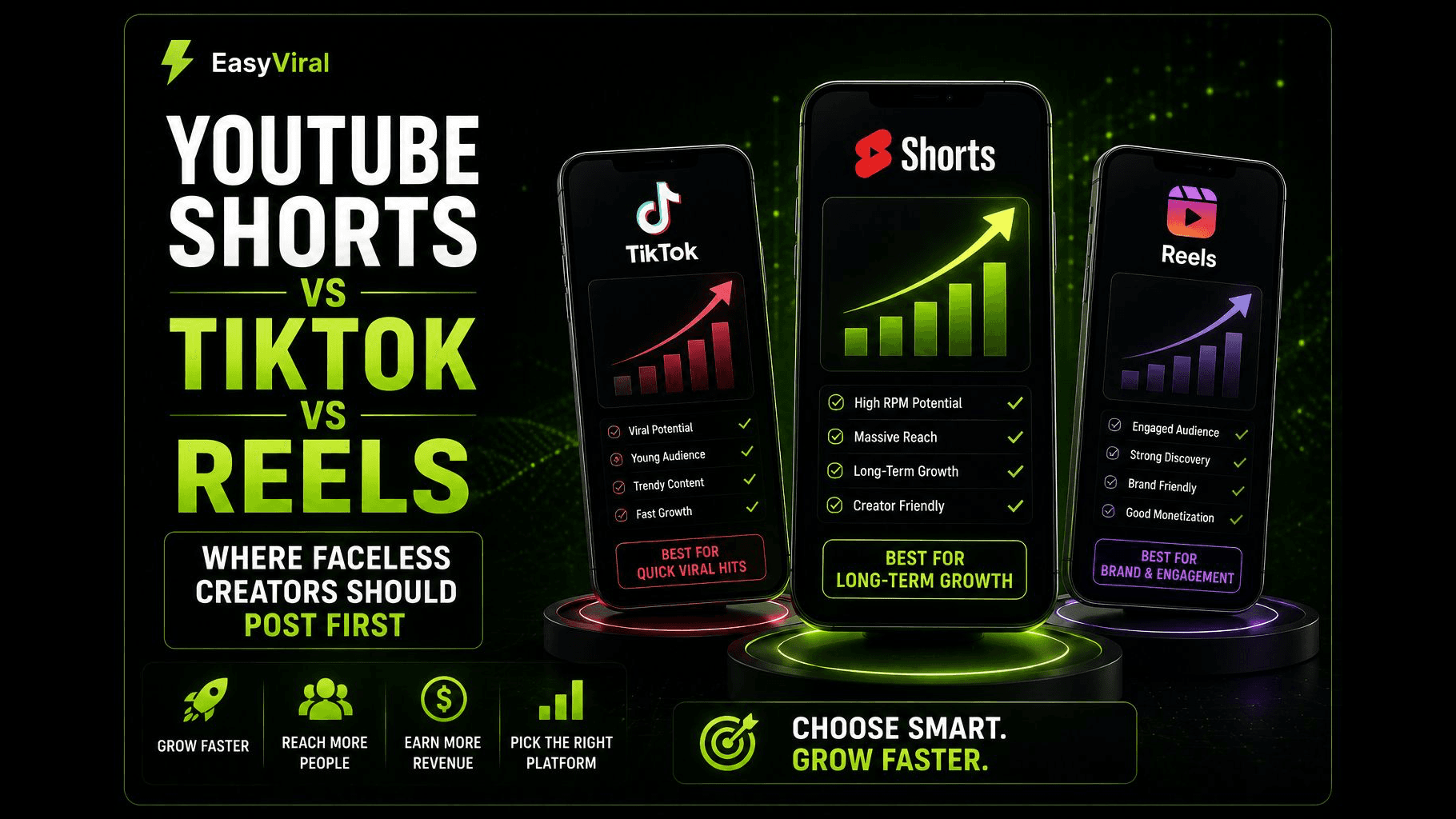
- Shorts vs. TikTok: why the same video performs differently on each platform
- The Shorts-to-long-form flywheel (where the real money is)
- What this means for faceless creators specifically
Most advice about the YouTube Shorts algorithm is recycled from 2024. "Post consistently." "Use trending sounds." "Add hashtags." That kind of thing.
The problem? The algorithm changed. Significantly.
YouTube rolled out satisfaction-based ranking for Shorts, shortened the test window to under an hour, and deployed new AI filters that actively suppress repetitive and low-effort content. If you're still running a 2024 playbook, you're fighting a system that no longer exists.
This post breaks down exactly how the Shorts algorithm works in 2026, what signals it actually cares about, and what gets your content buried before it ever reaches the feed.
How the Shorts algorithm decides who sees your video
Every Short goes through the same process. Understanding it changes how you approach content creation.
When you upload a Short, YouTube doesn't immediately blast it to millions of people. Instead, it runs a controlled test. Your video is shown to a small sample audience, usually within the first 30 to 60 minutes of posting. During that window, the algorithm watches how viewers react.
If the test audience responds well (they watch most of the video, don't swipe away, engage with likes/comments/shares), YouTube expands distribution. If the test audience bails, distribution stops. Your Short flatlines at a few hundred views.
This is why the first hour matters more than anything else. A perfectly optimized Short that bombs its test window is dead on arrival, regardless of how good the content actually is.
The algorithm then continues evaluating in waves. A Short that passes its initial test gets pushed to a wider audience. If that wider audience also responds well, it gets pushed again. This cycle can continue for days, weeks, or even months. Unlike TikTok, where most content peaks and fades within 48 hours, YouTube Shorts can keep generating views through search and recommendations long after posting.
The 6 signals that actually matter
Not all engagement signals carry equal weight. Here's what the algorithm prioritizes, ranked by impact:
1. Swipe-away rate (the killer metric)
This is the single most important signal for Shorts distribution. Swipe-away rate measures how many viewers scroll past your Short before it finishes playing.
The benchmarks are pretty clear. For Shorts under 30 seconds, you want a swipe-away rate below 25%. For 30-60 second Shorts, below 35% is healthy. Top-performing creators hit a 75-80% "viewed" rate versus 20-25% "swiped away."
If your swipe-away rate exceeds 40% in the first 3 seconds, the algorithm assumes your content isn't worth recommending and stops pushing it. That's the cutoff. Three seconds.
2. Watch-through rate (the retention test)
Watch-through rate measures what percentage of your Short the average viewer actually watches. YouTube's internal threshold sits at around 70%. Shorts that consistently land above 70% watch-through get aggressive promotion. Shorts that fall below it hit a distribution ceiling that affects your entire channel.
The algorithm adjusts expectations based on length. A 15-second Short needs near-complete watch-through to impress the system. A 55-second Short at 70% retention is considered strong. This is important because it means a well-made 45-second Short can outperform a mediocre 15-second clip, even though the shorter one will have a higher raw completion rate.
3. Replay/loop rate (the satisfaction multiplier)
When a viewer watches your Short more than once, the algorithm reads that as a strong satisfaction signal. Replays are weighted heavily because they indicate genuine interest, not passive scrolling.
This signal is particularly valuable for faceless content. Tutorial-style Shorts, data breakdowns, and "wait for it" reveals naturally drive replays because viewers want to catch details they missed the first time.
4. Shares (the distribution accelerator)
Shares carry more weight in 2026 than they did in previous years. YouTube treats shares as the highest-intent engagement signal because it means a viewer actively decided someone else should see your content. A Short with high shares and moderate likes will outperform one with high likes and no shares.
5. Comments (the depth signal)
Comments indicate that your content sparked enough of a reaction to make someone type a response. The algorithm doesn't just count comments. It also evaluates comment velocity (how quickly comments come in relative to views) and whether comments generate threaded replies.
6. Likes (the baseline)
Likes are still tracked, but they carry less algorithmic weight than they used to. YouTube recognized that likes are low-effort actions that don't reliably predict viewer satisfaction. A viewer can like a video and still swipe away from your next one. The algorithm cares more about what people do (watch, replay, share) than what they click.
What gets your Shorts buried
Understanding what the algorithm suppresses is just as important as knowing what it rewards. YouTube deployed several new AI-powered filters in 2026, and they're catching a lot of creators off guard.
Repetitive content detection
YouTube's anti-repetitive AI scans for Shorts that are too similar to content that already exists on the platform, including your own previous uploads. If you're posting the same format, same hook structure, and same visual style over and over, the algorithm starts throttling your reach.
This hits faceless creators especially hard because many rely on templated formats. A channel that posts 50 "top 5 facts about..." Shorts with identical transitions and voiceover style will see diminishing returns as the AI flags the content as derivative.
The fix isn't to change your niche. It's to vary your format, hooks, and visual approach within your niche. Same topic, different execution.
Platform watermarks
This has been a rule for years, but enforcement got stricter in 2026. Shorts with visible TikTok watermarks, CapCut logos, or other platform branding get reduced distribution. YouTube doesn't want to promote content that was clearly created for a competitor first.
If you're cross-posting between platforms, always download or export the original file before uploading to YouTube. Never screen-record from TikTok and reupload.
Low-quality AI content flags
In January 2026, YouTube suspended monetization on 16 of the top 100 most-subscribed AI-generated channels. These channels had a combined 35 million subscribers and billions of views. The crackdown targeted channels using synthetic narration over stock visuals with templated scripts and no original input.
YouTube's AI detection system now identifies synthetic voices, AI-created visual scenes, and deepfake-style footage automatically. This doesn't mean AI tools are banned. It means undisclosed, low-effort AI content gets flagged. Channels that use AI to enhance their production (better scripts, more polished visuals, faster editing) while adding genuine creative direction are fine. Channels that hit "generate" and post whatever comes out are not.
The distinction matters for faceless creators using tools like EasyViral. The tool handles the heavy lifting of production, but your creative input (niche selection, topic angles, scripting direction) is what keeps the content on the right side of YouTube's policies.
Failing the test window
If your Short doesn't hit performance thresholds in the first 30-60 minutes, the algorithm moves on. There's no "slow burn" rescue for Shorts the way there sometimes is for long-form videos.
This means posting time matters. If you publish at 3 AM when your audience is asleep, your test window plays out in front of the wrong people, and your Short might die before it ever reaches the right viewers.
The optimal Short in 2026: specs that perform
Based on the data, here's what a well-optimized Short looks like:
Length: 20-45 seconds is the sweet spot
Shorts can now be up to 3 minutes long (extended from 60 seconds in October 2024), but longer doesn't mean better. The performance sweet spot remains 20-45 seconds. By content type: 15-30 seconds for quick tips and facts, 25-40 seconds for tutorials and how-tos, 30-45 seconds for story-driven or narrative content.
A 20-second Short with 90% watch-through will crush a 3-minute Short with 15% completion. The algorithm cares about retention percentage, not raw length. If you can say it in 30 seconds, don't stretch it to 90.
Hook: the first 3 seconds decide everything
Your opening needs three layers working simultaneously: a visual that stops the scroll, a text overlay that creates a curiosity gap, and audio that reinforces the message. All three should hit within the first second.
What doesn't work: "Hey guys, welcome back." That's a channel introduction, not a hook. Starting with a greeting is the fastest way to trigger a swipe.
What works: numbered hooks ("3 settings that fix X"), mid-action starts where the viewer drops into an ongoing situation, and visual contradictions that make viewers think "wait, what?"
For faceless creators specifically, there's a data point worth noting. Research from several creator-focused platforms suggests that including an expressive human face in the first frame can significantly boost engagement. Since faceless channels can't do that, you need to compensate with bolder visuals, faster motion, and more aggressive text overlays in that opening frame. The gap exists, but it's closeable with better creative execution.
Posting frequency: 1-2 per day, quality over spray
The days of posting 5-10 low-quality Shorts per day are over. The algorithm's repetitive content filter actively penalizes that approach now. One to two Shorts per day is the sustainable baseline. Channels pushing 2-3 per day see 2-3x faster subscriber growth, but only if quality stays consistent.
For faceless channels using automation tools, this is the key balance. You can produce more, but every Short still needs enough variation in format and approach to avoid the repetition filter.
Posting time: match your audience's scroll hours
The highest-engagement windows are weekday lunch hours (12-3 PM) and evening mobile peaks (8-11 PM) in your audience's timezone. Weekend engagement tends to be highest on Friday through Sunday evenings.
That said, posting time is a minor variable compared to hook quality and retention. A great Short posted at a bad time will still outperform a mediocre Short posted at the perfect time. Don't stress the clock more than the content.
Hashtags: still useful, easily overdone
Hashtags still help with discoverability, but there's a hard cap. Use 3-5 relevant hashtags per Short, placed in the description rather than the title. Always include #Shorts as one of them. If you exceed 15 hashtags, YouTube ignores all of them.
Shorts vs. TikTok: why the same video performs differently on each platform
If you're cross-posting content, understanding the algorithmic differences between YouTube Shorts and TikTok is critical. They look similar on the surface but work very differently underneath.
Discovery model. TikTok runs a pure interest graph. Your follower count is nearly irrelevant. Every video gets tested fresh, and the algorithm decides entirely based on how strangers react. YouTube Shorts uses a hybrid model that factors in both interest signals and your channel's existing subscriber base. This means established YouTube channels have a built-in advantage that doesn't exist on TikTok.
Content shelf life. TikTok content peaks within 24-48 hours and then fades. YouTube Shorts can generate views for weeks or months because they surface through YouTube Search and recommendations, not just the Shorts feed. This is a major advantage for evergreen faceless content like tutorials, explainers, and niche education.
Monetization. YouTube Shorts RPM sits at $0.01-$0.07 per 1,000 views, significantly lower than long-form but with a clearer revenue model. TikTok's monetization varies more wildly and leans heavily toward brand deals and commerce integrations rather than ad revenue sharing.
The Shorts-to-long-form flywheel (where the real money is)
The smartest use of Shorts in 2026 isn't monetizing them directly. It's using them as a subscriber growth engine that feeds your long-form content.
Here's why this matters: Around 74% of Shorts views come from non-subscribers. That makes Shorts YouTube's most powerful discovery format. But one long-form video earns as much ad revenue as roughly 10 viral Shorts. The math is clear.
Channels that combine Shorts with long-form content grow subscribers 3x faster, with total watch time increasing 2.5x. The flywheel works like this: Shorts attract new viewers who've never seen your channel. End screens and pinned comments funnel interested viewers to your long-form content. That long-form content gets repurposed back into multiple new Shorts. Repeat.
For faceless channels, this flywheel is especially powerful because the same AI-generated assets (scripts, voiceovers, visual styles) can be adapted across both formats without starting from scratch each time.
What this means for faceless creators specifically
The algorithm doesn't penalize faceless content directly. YouTube evaluates viewer behavior signals, not production methods. If viewers watch, replay, and share your Shorts, the algorithm doesn't care whether there's a face on camera.
But faceless creators face indirect challenges. Many faceless channels overlap with patterns that YouTube's AI slop detection is trained to catch: synthetic voiceovers, stock visuals, templated scripts. Getting flagged isn't about being faceless. It's about being generic.
The creators winning with faceless Shorts in 2026 are the ones who treat AI tools as a production accelerator, not a replacement for creative thinking. They pick specific angles within their niche instead of covering the same surface-level topics everyone else does. They vary their formats so the repetition filter doesn't throttle them. And they disclose AI usage properly so YouTube's synthetic content policies don't catch them off guard.
The bar for faceless content is higher than it was two years ago. But the opportunity is also bigger. YouTube Shorts gets 200 billion daily views. The engagement rate sits at 5.91%, the highest of any short-form platform. And unlike TikTok, your content keeps working for you long after you post it.
The algorithm isn't the enemy. It's a filter. And the creators who understand how it filters are the ones whose Shorts actually get pushed.